The Book I Could Not Put Down
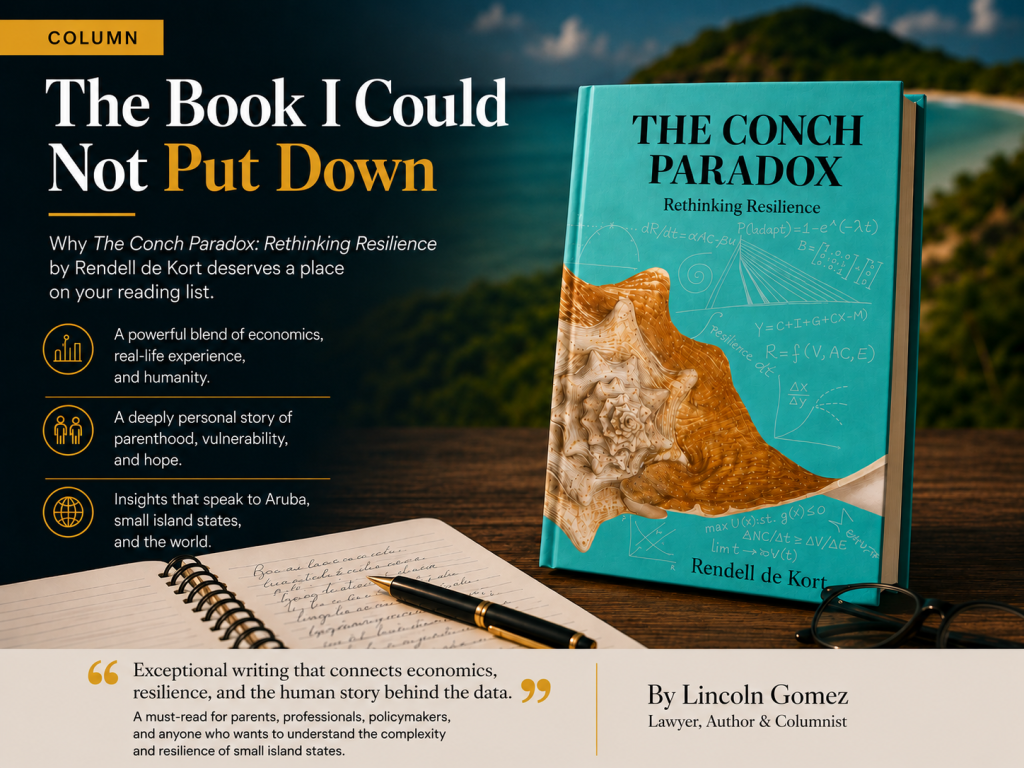
The Conch Paradox: Rethinking Resilience.
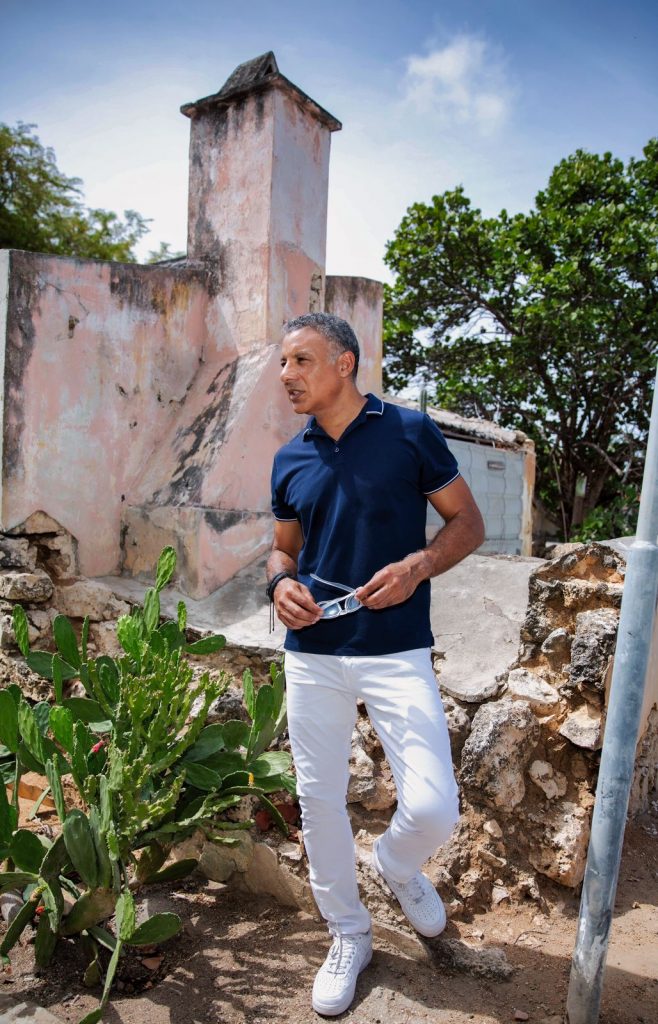
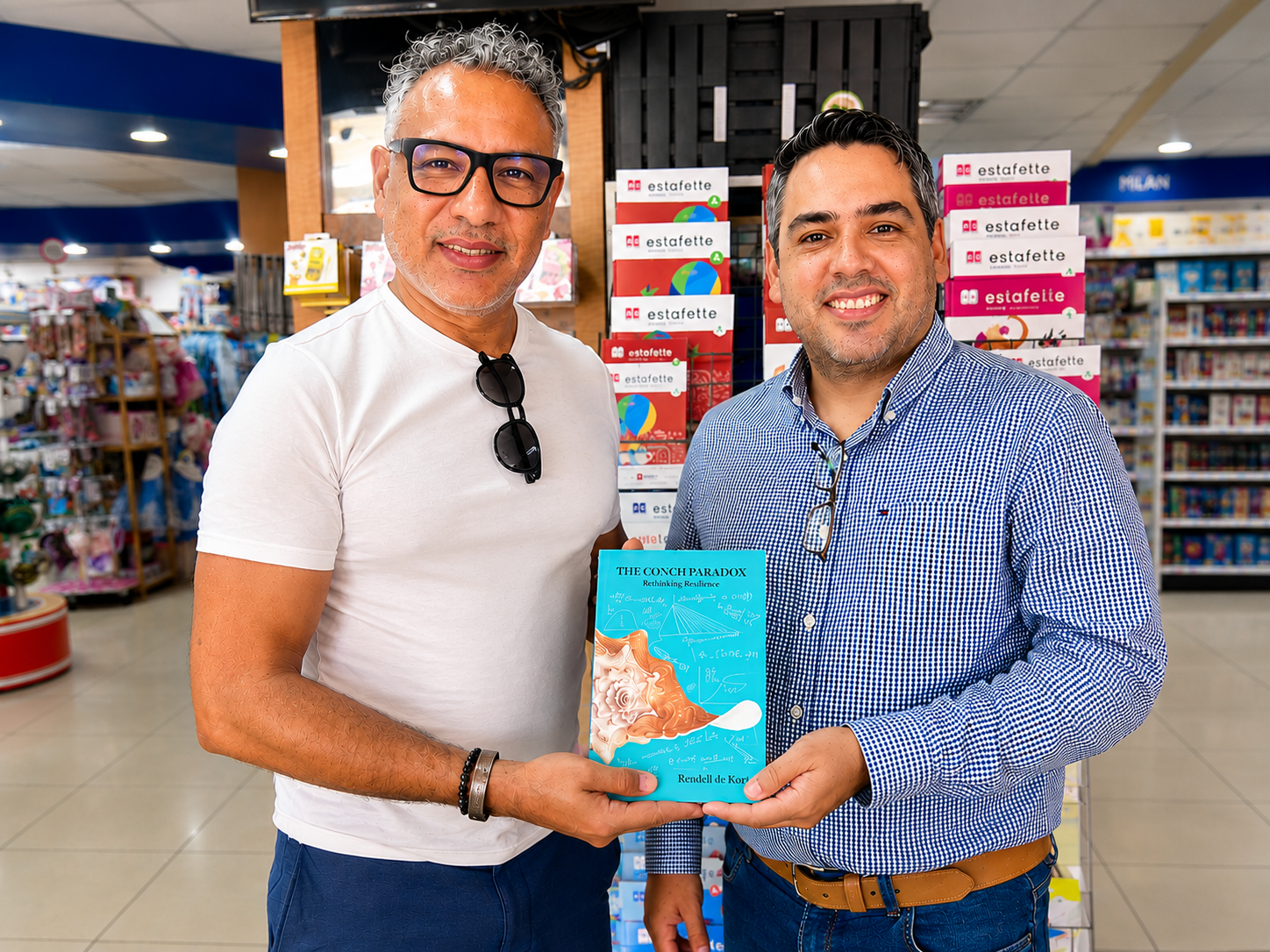
Earlier this week, I attended a book signing by Rendell de Kort, a development economist, Ph.D. researcher, and co-founder of the firm Cornerstone Economics whose work has focused extensively on resilience, economic vulnerability, and the realities facing small island developing states.
De Kort holds a Master of Science in Development Economics and served as a consultant to the World Bank, where he worked on projects involving resilience financing, economic development, and policy challenges impacting island economies across multiple jurisdictions. His research and professional work have also been associated with institutions, including the University of Aruba and the Vrije Universiteit Amsterdam.
I first came to know Rendell through our collaboration on 40 Years of Status Aparte, where he contributed an article titled: The Inheritance Paradox: A Generational Reflection on Success and Sovereignty
But after reading his newly published book, The Conch Paradox: Rethinking Resilience, it became immediately clear to me that Aruba is not only witnessing the continued growth of a serious economist and researcher.
We may also be witnessing the emergence of a remarkably mature literary voice.
I purchased a few copies of the book that afternoon. I had one autographed and quickly found homes for the others. Then I took my own copy home and did what I usually do with most books I buy.
I read the first ten pages first to see if it has legs. At least that was the plan. Something unusual happened. The book grabbed me almost immediately, and before the weekend even started, I had finished the entire thing.
That almost never happens anymore.
The older I become as a reader, the rarer it becomes to encounter a book that completely absorbs my attention.
We live in an age of constant distraction where focus itself has become fragmented. Many books are read because we seek information, perspective, or professional value from them. Not all possess the ability to genuinely pull the reader forward page after page. This one did.
More Than Economics
What impressed me most was not merely the subject matter, but the author’s writing itself. Rendell has mastered something exceptionally difficult: the ability to weave deeply personal and emotional human experiences into what many would consider the cold, technical world of economics.
And he does it masterfully.
Economics is often taught in detached language, wrapped in charts, theories, statistics, and policy jargon. Yet The Conch Paradox somehow humanizes these ideas without diluting their intellectual depth. The reader learns while simultaneously feeling emotionally connected to the story being told.
That is rare. Very rare.
At its core, The Conch Paradox is a book about resilience – personal resilience, societal resilience, economic resilience, and the hidden fragility that often exists beneath systems we believe are strong. Through deeply personal experiences, island realities, and economic analysis, de Kort explores how the very structures designed to protect us can sometimes become the things that ultimately constrain us.
But what surprised me most was the emotional depth hidden beneath what initially appears to be a book centered on resilience theory and economics.
This is not simply a book about systems, economics, or resilience.
It is also a story about parenthood, vulnerability, fear, uncertainty, and the fragile reality that even the things designed strongest in life can suddenly reveal how delicate they truly are.
And perhaps that emotional surprise is precisely what makes the book so difficult to put down.

The Meaning Behind the Title
The title itself, The Conch Paradox, intrigued me from the beginning, though I must admit that only after reading the book did I fully appreciate the brilliance of the metaphor it conveys.
The conch shell ultimately becomes a powerful symbol for resilience, protection, adaptation, and vulnerability all at once.
Still, somewhere in my reading, I found myself thinking that perhaps a different title, subtitle, or cover might have better prepared readers for the profoundly human story waiting beneath the surface. But then again, perhaps that is precisely the beauty of de Kort’s choice. The title does not explain itself up front. Like the book itself, it slowly unfolds. And by the final pages, the metaphor makes perfect sense.
A Story About Partnership
What also deserves recognition is that while this is Rendell de Kort’s book and his voice carries the narrative, the emotional foundation of the story clearly rests on a partnership.
His wife, Lay Hing De-Kort Yee, holds a Master’s of Science degree in Finance, and is a professional, but foremost a mother who is inseparable from the journey the reader experiences throughout the book. Together, Lay and Rendell navigate the fear, uncertainty, and emotional complexity surrounding the health struggles of their unborn child and later their young son.
That shared humanity is what gives the book much of its emotional credibility. Behind the academic frameworks, economic theories, and discussions on resilience are two parents confronting something universal: vulnerability. And perhaps that is precisely why the book works so well. It never hides behind intellectualism.
Instead, it shows that even highly educated, accomplished, and professionally successful individuals are ultimately human beings navigating fear, vulnerability, hope, love, and uncertainty like everyone else. That balance is extraordinarily difficult for a writer to achieve.
Interestingly, the book also suggests that Lay herself is/was also working on a book. I sincerely hope she does. I can’t tell whether it will be her angle on their journey or something entirely different. Either way, I will get a copy in due time, read the first ten pages, and see.
While The Conch Paradox is unquestionably Rendell’s work, its emotional gravity clearly emerges from a shared human experience lived through as partners, parents, and professionals navigating uncertainty in real time.
And after finishing this book, I cannot help but feel that there are still more important stories waiting to be told.
A Book That Travels Beyond Aruba
What makes the book even more remarkable is the range of people who will find themselves inside its pages.
Parents will connect emotionally to the vulnerability, fear, and humanity woven throughout the story. Parents-to-be will likely read parts of it differently after understanding the struggles surrounding a child’s health and the uncertainty that accompanies it.
Professionals, entrepreneurs, policymakers, and business leaders will appreciate the book’s deeper exploration of resilience, systems, island economies, and the hidden fragility that small island states like Aruba continuously navigate.
And somehow, Rendell manages to speak to all those audiences at once without losing the reader along the way. That is not easy to do.
Behind every successful entrepreneur, executive, policymaker, or professional often stands something much more human: a parent, a family, vulnerability, fear, responsibility, and hope. This book understands that intersection exceptionally well.
Perhaps that is why it resonates so strongly.
I could easily imagine a book like this sitting in the rooms of our hotels, offering visitors a deeper understanding of Aruba beyond tourism imagery and postcard narratives. It tells a deeply personal story while simultaneously helping readers better understand the economic and social dynamics that shape islands like ours.
That is valuable.
Policymakers, foreign officials, investors, and international partners visiting Aruba would likely recognize many of the tensions described throughout the book because the themes explored are not limited to one island, and perhaps they will even understand us better..
This is not simply a good local publication. I benchmarked it against my reading list, and I can tell you hands down, it is an exceptional book by any standard. And it deserves a place on your reading list.
A Remarkable Literary Voice
This week, as I prepared to serve as a keynote speaker at Rotaract’s “Orange Economy” event, to be held on June 2nd, 2026, focused on creativity, innovation, intellectual property, and the future of our creative industries, I could not help but think about this book.
Because this is exactly what the creative economy should look like.
A young Aruban economist using his academic expertise, personal experiences, storytelling ability, and intellectual curiosity to create meaningful work that contributes not only to Aruba but to broader global conversations about resilience and society.
That deserves recognition.
Too often, we underestimate the intellectual and creative capacity that exists within our own community. We assume that globally relevant books, ideas, or thought leadership must come from somewhere else.
This book reminds us otherwise.
What Rendell de Kort has produced with this first publication is not merely impressive for a debut author. It is impressive, period.
I sincerely hope this book succeeds commercially. Not simply because Aruba should support local authors, but because exceptional work deserves recognition wherever it originates.
More importantly, however, I hope this is only the beginning of Rendell de Kort’s writing journey.
Because if this first book is any indication, Aruba may have gained not only a respected economist and policy thinker, but also a remarkably mature literary voice capable of contributing meaningfully to conversations far beyond our shores. And that is something worth paying attention to.
Final Recommendation
So let me be very direct with my recommendation.
Do not buy this book out of charity.
Do not buy it merely to “support a local author.”
Buy it because it is genuinely worth reading.
Buy it because it will teach you something.
Buy it because it will move you.
Buy it because if you are someone who keeps a stack of books beside your bed every year, this is one that belongs on that stack.
The Conch Paradox: Rethinking Resilience is currently available at Plaza Bookshop and De Wit & Van Dorp. In the Netherlands, it is available at Donners. The eBook is available on Amazon.
My recommendation?
Get your copy before they are all gone.
Have a wonderful week, and I will see you all next week.
And do not forget to visit my website www.lincolngomez.com, where you can find all my blogs, podcasts, and weekly columns.
#Books #Writing #Leadership #Economics #Resilience #Aruba #Caribbean #SmallIslandStates #CreativeEconomy #Policy #Parenthood #Authors #BookReview #IntellectualLeadership #Reading