When External Shocks Hit Small Economies
Sometimes a single announcement tells a much bigger story about the vulnerability of small economies.
The recent decision by King Ocean Services to sharply increase its bunker surcharge on cargo shipments to Aruba, Curaçao, and Bonaire is one such example.
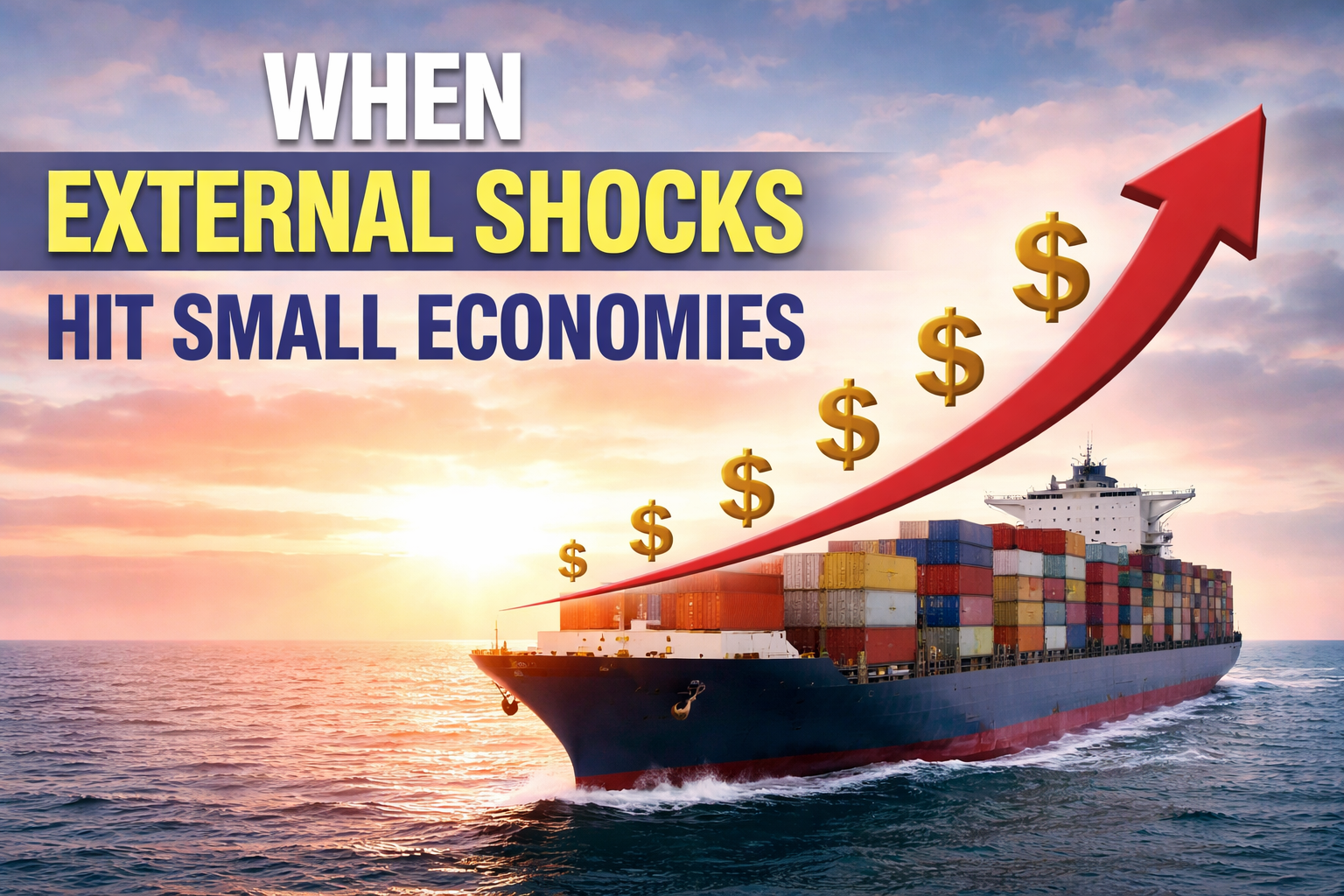
Starting April 12, the fuel surcharge on a 40-foot container will jump from $400 to $1,400 – an increase of roughly 250 percent in the surcharge itself. In practical terms, however, this translates into about a 25 percent increase in total freight costs for a typical container.
This increase does not occur in isolation. Recent global shipping advisories point to disruptions in international energy markets and key maritime routes, driving sharp increases in fuel and insurance costs across the industry. In other words, this is not a local decision, but a global shock with direct local consequences.
That may not sound catastrophic at first glance. But in a small island economy that depends heavily on imports, the ripple effects are immediate and unavoidable.
The Reality of Economic Exposure
Aruba imports the overwhelming majority of what it consumes – food, consumer goods, construction materials, and equipment. When shipping costs rise, the effect spreads rapidly throughout the economy.
Importers pay more. Businesses pay more. CConsumers (you and I) pay more.
The increase moves through the entire supply chain and ultimately shows up in the price tags on supermarket shelves and store counters. In an economy where households are already dealing with rising living costs, even moderate shocks can quickly compound existing pressures.
This is the structural reality of a small island economy deeply integrated into global trade networks.
A Known Structural Vulnerability
This dynamic is not new.
In his contribution to the book 40 jaar Status Aparte: Tussen Voortgang en Stilstand, professor Jorge R. Riddestaat, Ph.D , University of Central Florida – Rosen College of Hospitality Management, drew an important parallel between Aruba’s historic oil economy and its later tourism economy.
Both economic models, he argued, share a fundamental characteristic: they are highly susceptible to external shocks.
The island does not control global oil prices. Nor does it control global tourism cycles. Yet both have historically had a decisive influence on Aruba’s economic trajectory.
The current situation illustrates that this vulnerability extends even further. Aruba’s geographical position, combined with its heavy dependence on freight connections with the United States, places the economy squarely at the mercy of developments beyond its control.
The Hidden Fiscal Effect
There is another dimension to this development that deserves attention.
When freight costs rise, government revenue rises with it.
In Aruba, import duties and the BBO tax at the border are calculated based on the CIF value of goods – Cost, Insurance and Freight. This means taxes are applied not only to the value of the product itself, but also to the cost of transporting and insuring that product.
As a local logistics businessman recently pointed out, when shipping costs increase, the taxable base increases as well. This is simple math
The result is unavoidable: the government automatically collects additional tax revenue that was never originally budgeted – not because of growth, not because of policy, but simply because costs increased.
That raises a simple question: should the government benefit from a shock that is making life more expensive for everyone else?
Within Aruba’s system of regulated prices for basic goods, increases in shipping costs are passed directly into consumer prices, since maximum prices are calculated based on landed cost. In practice, this means that external shocks are not absorbed they are transmitted.
The result is a double effect: consumers pay more at the register, while government revenues rise automatically through higher CIF-based taxation without any policy change.
As one of my compadres put it:
“When external shocks drive up import costs, governments must be careful not to become unintended beneficiaries of inflation. Fiscal policy should cushion the shock – not profit from it.”
A Strategic Response
External shocks require flexibility.
When an economy is hit by developments beyond its control – whether rising fuel prices, geopolitical tensions, or disruptions in global logistics – governments must be able to pivot and adjust.
One option would be to temporarily exempt essential consumption goods from import duties. Another would be to adjust how CIF values are used for taxation, temporarily excluding the freight and insurance components from the calculation.
Either measure would help soften the inflationary effect that higher shipping costs will inevitably have on the economy. These do not need to be permanent changes. They can be designed as temporary stabilization measures, activated during periods of unusual external pressure.
Policy Agility in a Small Economy
Small economies do not control global fuel markets. They do not control geopolitical tensions, maritime insurance markets, or global shipping routes.
What they can control is how they respond. The announcement by King Ocean is yet another reminder that Aruba operates within a highly interconnected – and often volatile – global system. External shocks will occur from time to time.
The real question is whether we have the policy agility to respond when they do. Because when global waves hit a small island economy, the impact is never theoretical. It is felt directly – by every business, every household, and every consumer on the islan
Thank you for reading. I’ll see you next week.
Visit my blog to find all my posts.
Listen to my Podcasts.
Watch my YouTubeChannel