Governance Without Guardrails: The Ennia Judgment
A case study in how informal culture, unchecked authority, and absent oversight led to nearly four million in unauthorized payouts—and what the court did about it.
The following case concerns Ennia in Curaçao, not to be confused with Ennia Aruba. This ruling by the appellate court (Joint Court of Justice) involved Ennia Caribe Holding N.V. and Ennia Caribe Invest N.V., part of the Ennia insurance group – a non-financial institution under the supervision of the Central Bank of Curaçao and Sint Maarten (CBCS).
On April 15, 2025, the Court issued a landmark decision with implications for corporate governance throughout the Dutch Caribbean. At the center of the case was a former statutory director of Ennia and his management company. The outcome: a decisive affirmation of civil liability for years of unauthorized financial benefits – paid without proper oversight, documentation, or approval by the board of supervisory directors (Raad van Commissarissen), as required by policy.
This case was litigated by highly experienced and esteemed legal professionals on both sides, resulting in a thorough and intense clash – a true legal contest between seasoned Curacao lawyers Mirto Murray and Karel Frielink. The complexity of the arguments and the scale of the proceedings made this not only a significant judgment but a clear example of how serious governance failures are treated when brought fully into the light of the law.
While the ruling dealt solely with civil claims, the broader message is clear: informality in governance is not a shield against accountability.
The Core Findings
The case focused on the period between 2015 and 2018, during which the director authorized NAf 2.39 million in “bonus advances” to his management company. These payments were made without the required approval of the board of supervisory directors, as outlined in the group’s remuneration policy. That figure alone raised eyebrows: the advances amounted to nearly five times the director’s fixed annual salary of USD 300,000. The court found no legal or contractual basis for the payments. Oral consent – whether from the majority shareholder or other executives – was deemed insufficient.
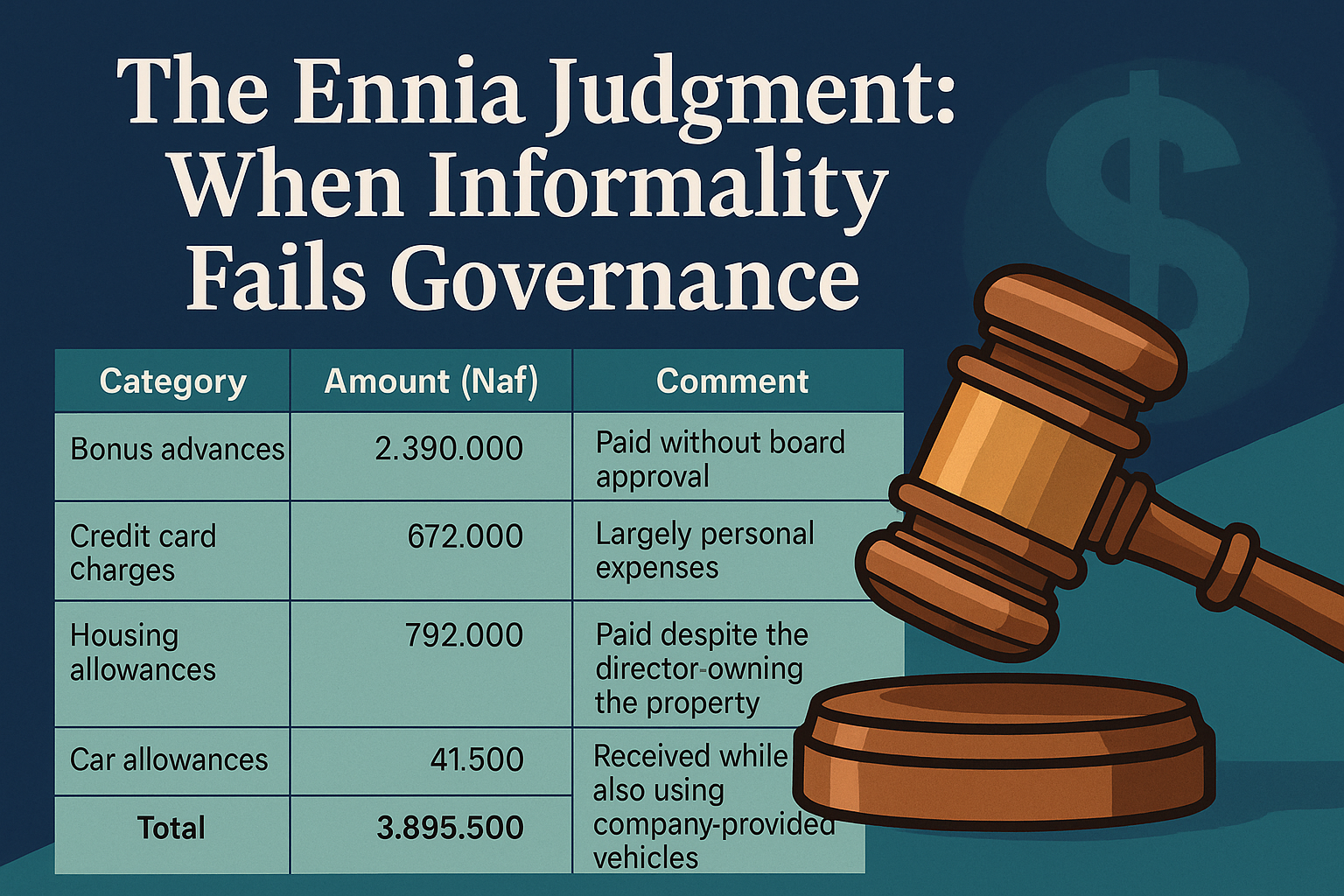
In addition to the bonuses, the director incurred NAf 672,000 in credit card charges, a significant portion of which were deemed personal expenses. Ennia also paid NAf 792,000 in housing allowances and NAf 41,500 in car allowances, even though the director already owned the home and was provided company vehicles.
To put the scale of these payments into perspective:
| Category | Amount (NAf) | Comment |
| Bonus advances | 2,390,000.00 | Paid without board approval |
| Credit card charges | 672,000.00 | Largely personal expenses |
| Housing allowances | 792,000.00 | Paid despite the director owning the property |
| Car allowances | 41,500.00 | Received while also using company-provided vehicles |
The appellate court reviewed each category of payment and found that none met the requirements for lawful compensation. There were no supervisory board approvals, no formal justifications, and no sufficient documentation. The conclusion: the benefits were unjustified and must be repaid.
Oversight Structures: Present on Paper, Absent in Practice
What makes the case particularly striking is how long these practices continued without interruption.
Ennia, was under supervision by the Central Bank of Curacao and Sint Maarten. For years, significant sums were transferred based on informal arrangements and unwritten understandings. There was little evidence of internal audit objections, supervisory board intervention, or administrative controls being enforced. This wasn’t just a failure of executive leadership. From related proceedings involving members of the supervisory board, we’ve learned that those members also erred. Several are now being held accountable by Ennia and through the courts, further highlighting that this was not an isolated lapse; it was a systemic breakdown in governance.
The court did not speculate on how or why this occurred – but the facts speak to the erosion of formal control mechanisms. The ruling made clear that corporate culture, no matter how entrenched, does not override the requirement for legal compliance and documented approval.
A Regional Relevance
Although this matter unfolded in Curaçao, it is relevant to other islands of the Dutch Caribbean, particularly Aruba, where similar structural vulnerabilities can loom, especially within state-owned enterprises.
In Aruba, politicians frequently make appointments to boards and executive positions in public companies, often without independent screening or professional selection criteria. More disturbing is that they are usually appointed without any relevant qualifications other than being party loyalists. Sort of a carrot for the loyal supporters. This dynamic increases the risk that supervisory boards may operate with limited independence and that directors may feel more aligned with political patrons than with their fiduciary duties.
When oversight becomes informal or politicized, it creates space for practices that, while normalized internally, may not stand up under legal scrutiny. The Ennia ruling is a reminder that informal customs do not neutralize formal responsibilities.
Institutional Intervention That Mattered
It’s worth noting that the Central Bank of Curaçao and Sint Maarten (CBCS) did intervene decisively. In 2018, it imposed an emergency regime at Ennia and initiated the process that brought these issues to court. That intervention was not only appropriate – it was essential. It shows the importance of strong regulatory mechanisms when internal governance falls short. It is also worth noting that the Ennia Aruba entities are under the jurisdiction of the Central Bank of Aruba. See the CBA statement on this regard.
Three Takeaways for Directors and Boards
First, informal practices may evolve but do not override written policies and statutory duties. If something requires approval, it must be approved appropriately every time.
Second, internal culture is no substitute for formal oversight. Good governance is about intent, process, documentation, and accountability.
Third, this ruling underscores that fiduciary responsibilities are enforceable. Directors and supervisory boards – especially in regulated sectors or state-affiliated entities – must adhere to the letter of internal controls, not just their spirit.
See you next week – and don’t forget to visit my new website www.lincolngomez.com for all the latest blogs and podcasts. In governance, as in life: if you have to approve your own bonus, maybe don’t.