Part II: Ennia’s Billion-Guilder Breakdown
An earlier court ruling reveals how oversight failed long before the headlines – offering lessons still unlearned.
When institutions fail, the conversation often starts with money – how much was lost, who got paid, and what vanished. But beneath every financial collapse is something deeper: a failure of governance. A breakdown not just in decision-making, but in the structures and people meant to guard against excess and abuse.
That’s why, while writing recently about the latest chapter in the Ennia saga, I went back to the judgment that laid its foundation: ECLI:NL:OGHACMB:2023:158. Though issued earlier, it captures the moment when governance at Ennia stopped being a system and became a show.
The judgment is anonymized. I refer to the key figures as [A], [B], [C], [D], and [E], in line with the court’s anonymization format. Their names aren’t the story. Their actions – and inactions – are.
The Hollowing Out of Oversight
On paper, Ennia had the makings of a well-governed financial institution: a board, a supervisory council, an investment committee, and compliance protocols. In practice, everything revolved around one figure: [A].
The court found that decision-making bodies didn’t challenge – they obeyed. Supervisory directors didn’t supervise – they enabled. Governance became performance, not protection. This is one of the most important lessons of the Ennia case: corporate structures can exist and still mean nothing if no one inhabits their role with independence and integrity.
Fiduciary Duty, Forgotten
The court used two standards to assess the conduct of those involved: an objective and a subjective test.
The objective test asked what a prudent director or supervisor would have done in the same circumstances – a way to benchmark behavior against the professional norm expected in a regulated industry like insurance.
The subjective test examined whether the individuals actually knew – or should have known – that their actions were likely to cause harm. This allowed the court to determine not only whether conduct fell short of expected standards, but whether it was carried out with conscious disregard for Ennia’s interests. Both tests pointed to the same conclusion: the individuals in charge failed, both in their judgment and in their duty.
After the 2005–2006 acquisition by Parman International, Ennia’s group structure was reengineered to move assets into affiliated entities, outside the reach of regulatory supervision.
For an insurance group responsible for protecting policyholder savings, this wasn’t just questionable – it was indefensible.
Reckless Investments and Conflicted Interests
Two investment decisions became emblematic of the problem: Ennia Leven’s deep exposure to S&S, a U.S. company with a CCC credit rating, and the real estate project Mullet Bay.
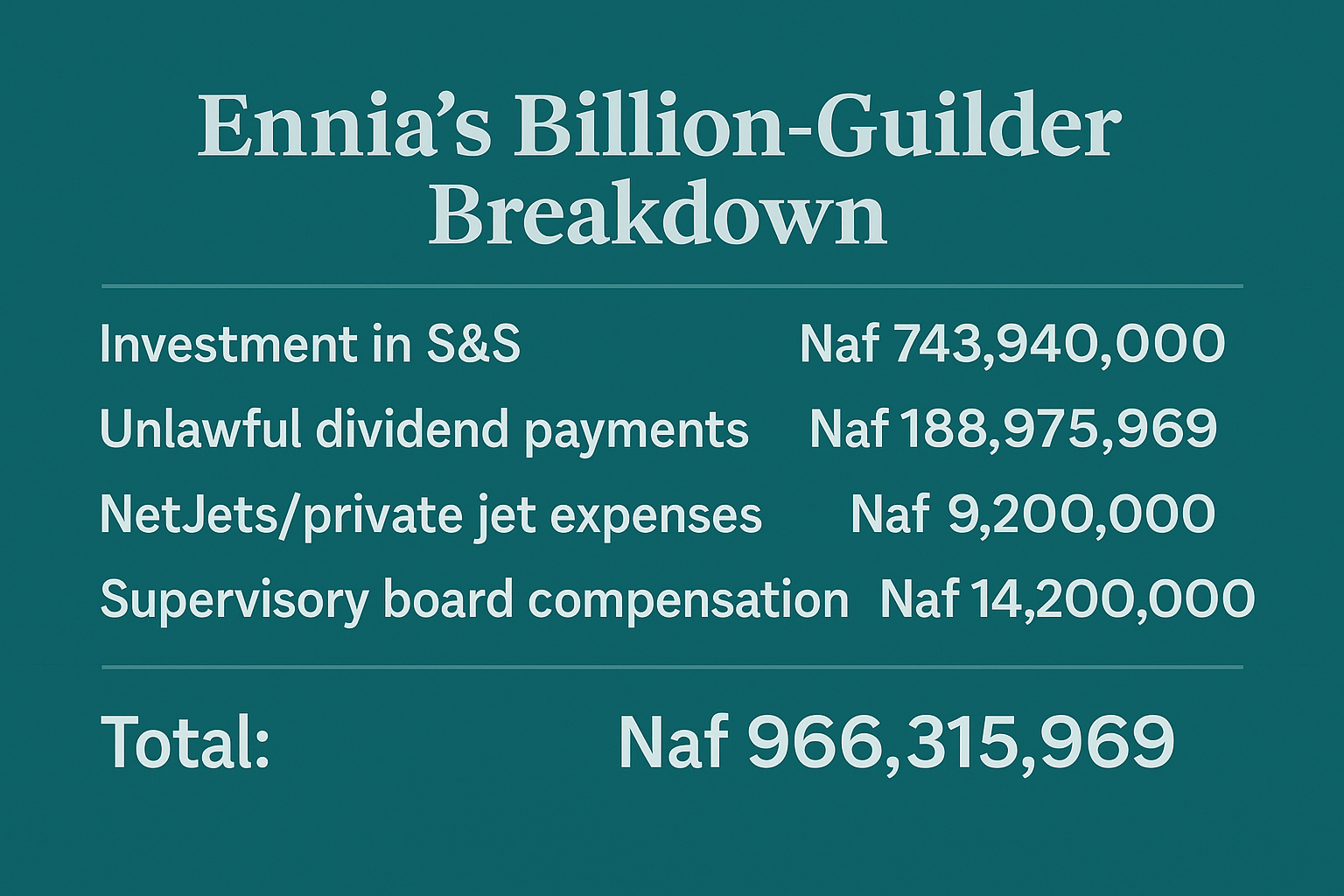
The S&S deal alone produced a loss of NAf 743.94 million. Structurally, the deal offered little control, few safeguards, and no realistic return horizon. It was also deeply conflicted: [A] had personal financial interests on both sides of the transaction.
The court didn’t interpret that as bad luck or market volatility. It called it a breach of trust.
Waste Without Oversight
The financial losses weren’t limited to investments. They extended to what the court described as excessive and unjustified spending:
- NAf 188.9 million in dividends, paid at the expense of solvency
- NAf 10 million in donations, with no approval or corporate justification
- NAf 9.2 million in NetJets private jet expenses, primarily for [A]’s personal use
- Millions in inflated salaries, sham consultancy agreements, and supervisory fees disconnected from any actual oversight
The NetJets flights, in particular, revealed how disconnected the spending was from any business purpose. According to the judgment, the flights covered destinations including Curaçao, the Bahamas, Europe, the U.S., Mexico, and Morocco – none of which appeared necessary for Ennia’s operations.
| Category | Amount (NAf) | Court’s Findings |
| Investment in S&S | 743,940,000 | Losses due to high-risk investment and conflict of interest |
| Unlawful dividend payments | 188,975,969 | Paid without legal basis, harmed solvency |
| NetJets/private jet expenses | 9,200,000 | Primarily for personal use by [A], not business-related |
| Donations | 10,000,000 | Undocumented, unauthorized, no business justification |
| Supervisory board compensation | 14,200,000 | Deemed excessive and unsupported by actual oversight |
| Total | 966,315,969 | Personal liability assigned across defendants |
The court concluded they were unauthorized, undocumented, and unjustified.
Supervisory Board Compensation: Pay Without Oversight
Beyond the headline figures, the court closely examined the compensation awarded to Ennia’s supervisory board members. Ennia argued these payments were excessive, and the court agreed. It found that a total of NAf 14.2 million had been paid to supervisory directors – without any substantiated link to governance duties actually performed.
The court emphasized that oversight is not ceremonial. Supervisory directors are not entitled to compensation merely for holding a title; they must provide active, independent oversight. In this case, the court concluded that this standard was not met and ruled that the entire amount must be repaid.
The message was clear: being a passive or compliant board member is not only a breach of duty – it may carry real financial consequences.
Legal Defenses Carefully Considered – and Rejected
The court examined several legal defenses put forward by the defendants, many of whom were experienced professionals. These arguments were not without legal basis – and in a more conventional commercial context, some might have warranted serious consideration. But in this case, the court found they could not be sustained given the scope and nature of the misconduct.
- Statute of limitations: It was argued that the claims were time-barred. However, the court found that the concealment of key facts delayed the start of any limitation period.
- Article 6:89 Civil Code: The defense suggested Ennia failed to raise objections in time. The court ruled that this requirement was inapplicable in a setting where the individuals responsible for reporting concerns were also responsible for the misconduct.
- Decharge declarations: Typically intended to release directors from liability, decharge does not cover acts that were concealed or grossly negligent.
- “We followed procedure”: The court acknowledged the presence of formal processes but concluded they were either manipulated or empty. Procedures without oversight are no defense against breaches of fiduciary duty.
Real People, Real Liability
The court held [A], [B], [C], [D], and [E] personally liable for over NAf 1 billion in damages. These were not general accusations – they were assigned by damage category: failed investments, unlawful dividend payments, unjustified donations, and private expenses.
- [A] bore the widest responsibility, both formally and in practice
- [B] and [C] functioned as de facto executives
- [E], as CEO, failed to act despite having the authority and obligation to intervene
This wasn’t just about control. It was about silence, complicity, and the abdication of oversight.
What This Teaches Us – Still
So why revisit an older ruling in light of newer events? Because this judgment tells the deeper story behind the Ennia headlines. It reminds us that governance doesn’t fail all at once – it fails quietly, when roles become ceremonial and structures lose meaning. And when those responsible for protecting the institution serve something else instead.
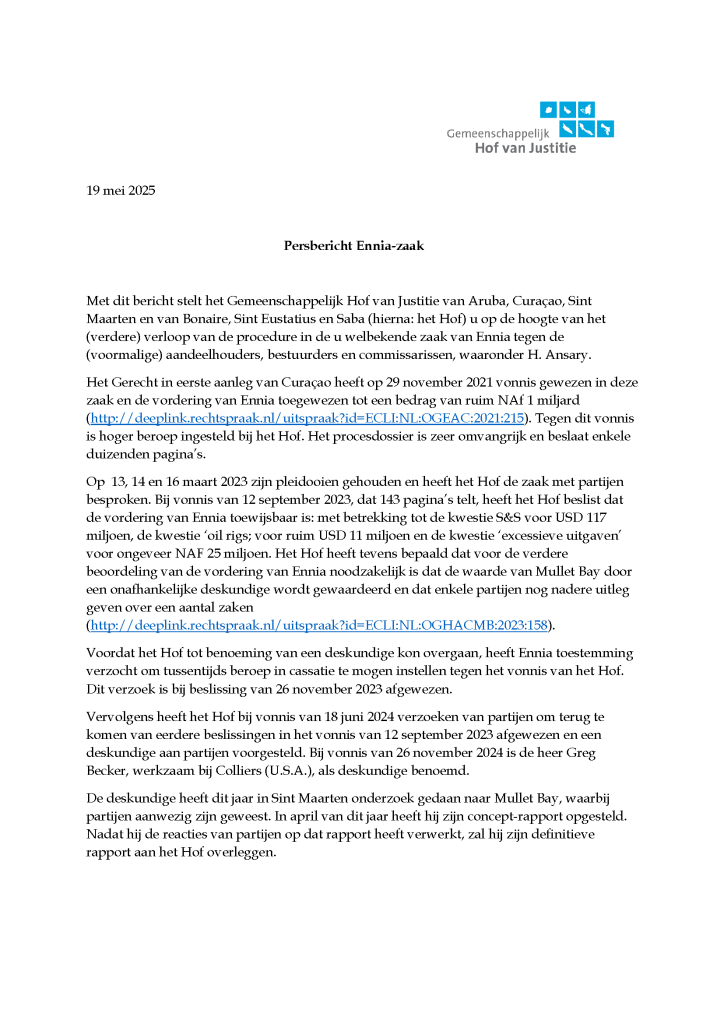
As confirmed in a press release from the Joint Court of Justice dated 19 May 2025, the case is still active. A final ruling is pending the independent valuation of Mullet Bay, along with additional written submissions and clarifications on several disputed expenses. While core liabilities—ranging from the S&S investment to excessive outflows—have already been upheld, the process of final accountability is ongoing.
This isn’t just a postmortem. It’s a live case study in how institutional trust is eroded – and how long it takes to restore clarity. The Ennia judgment isn’t finished. And neither is the lesson.
Thanks for reading. If this resonated, take a moment to:
- Connect with me on LinkedIn or follow me to stay updated on new posts and columns
- Subscribe to my newsletter on LinkedIn
- Visit my blog: www.lincolngomez.com/blog
- Or just email me at with your thoughts, questions, or feedback
I’ll see you next week.