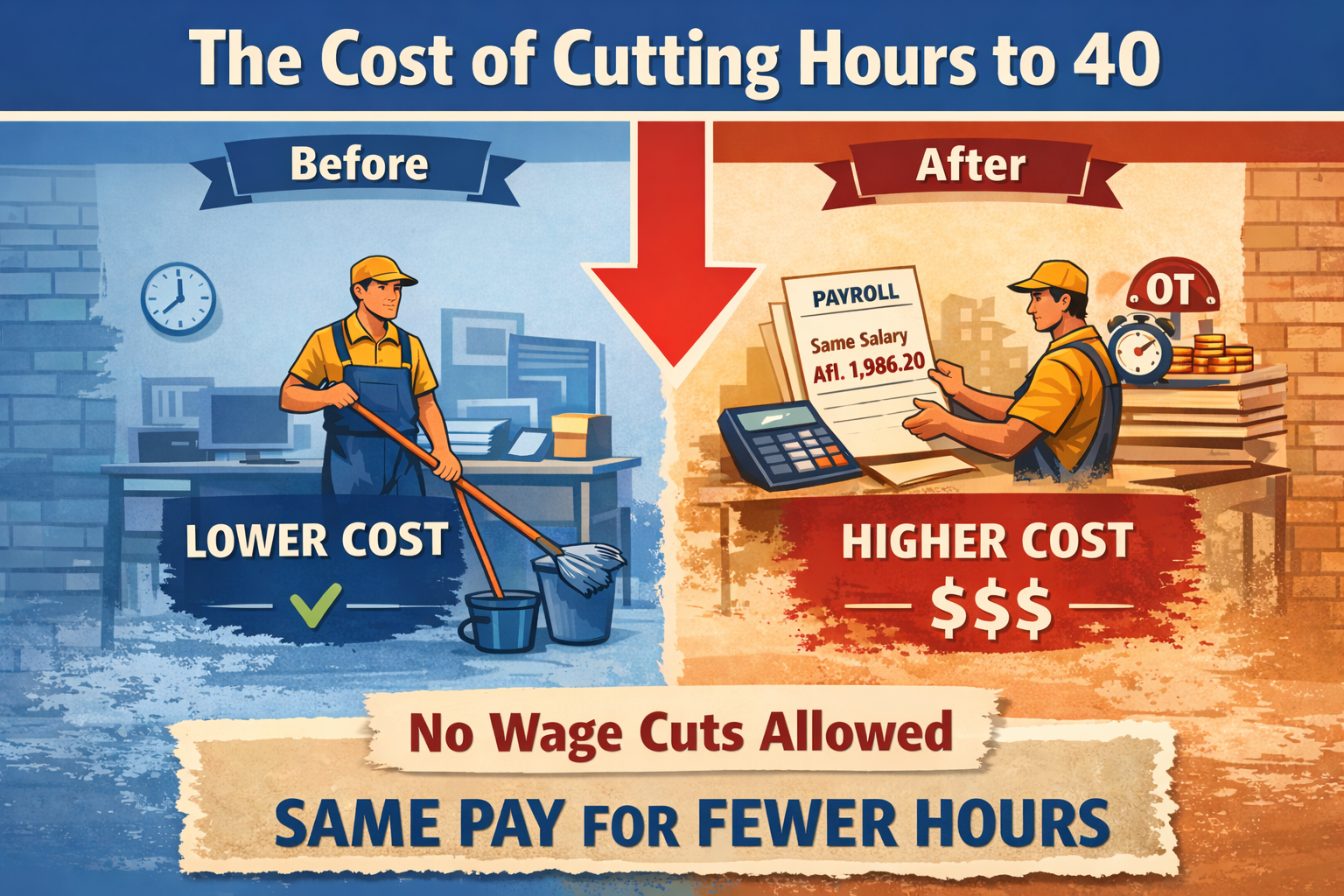
No Discounts Allowed:How the 2026 Workweek Reform Quietly Raised Labor Costs
Back in late 2024, I warned that the shift from a 45-hour to a 40-hour workweek was not going to be the neutral, technical adjustment the government made it out to be. It was going to cost more. Not just eventually, immediately. And now that the change has taken effect in 2026, the numbers confirm what many suspected, but few were willing to say out loud.
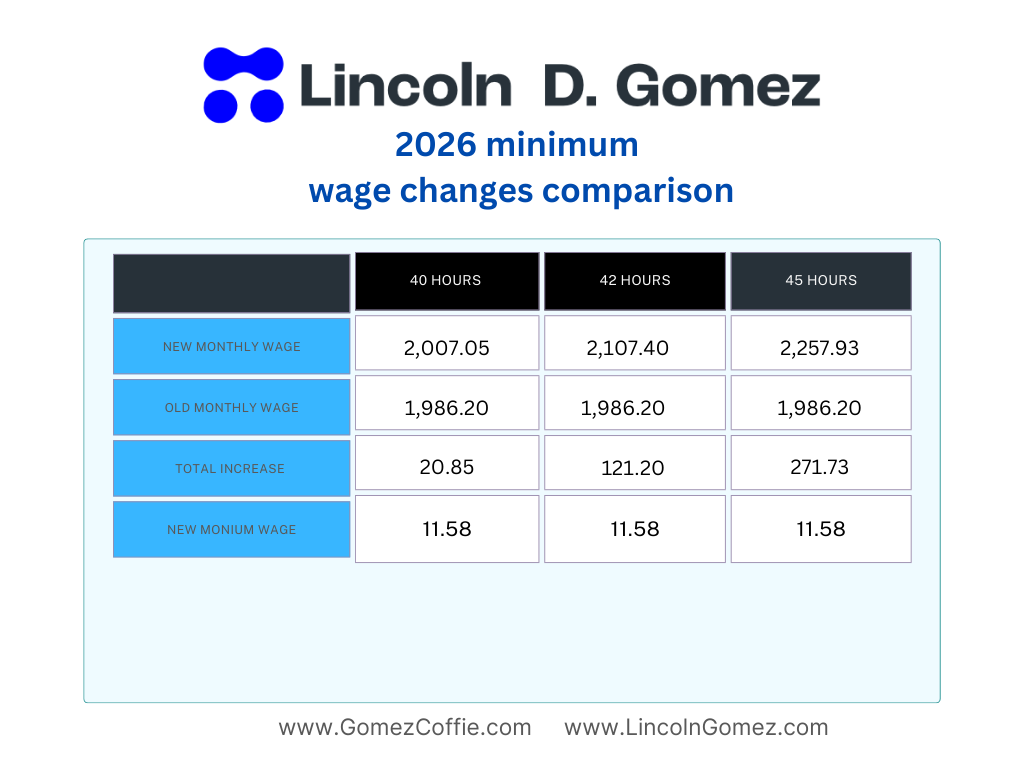
Although the government initially decided not to implement a fixed minimum hourly wage in 2024, it introduced the law later, and it took full effect in January 2026. The law now sets a uniform minimum wage of Afl. 11.58 per hour, regardless of whether an employee works 40, 42, or 45 hours per week. The number of hours worked didn’t change, what changed was the legal minimum cost per hour. That shift is what now drives the increase in monthly wages.
This adjustment was presented as a modernization measure, aligning Aruba with international standards. But the financial impact on employers didn’t come from a reduced workweek. It came from the way the fixed hourly rate multiplied across the actual hours worked, pushing monthly wages upward, sometimes significantly.
For instance, someone working 45 hours per week previously earning Afl. 1,986.20 must now legally earn Afl. 2,257.93. That’s the direct result of multiplying 45 hours by 4.333 weeks by the new hourly minimum of Afl. 11.58. As shown in the graphic, even a 40-hour employee now has a new wage floor of Afl. 2,007.05 per month.
But the cost increase doesn’t stop there. Aruban labor law, grounded in the Civil Code, doesn’t allow employers to reduce an employee’s monthly wage simply because they decide to reduce working hours. That rule existed before the 2026 reform and continues to apply.
So whether the employer keeps a worker at 45 hours or reduces them to 40, they cannot lower the monthly wage without the employee’s consent or court approval. This means that unless renegotiated with each individual employee, the employee keeps their full salary, while the employer now has to pay 5 more hours of work per week.
The setup: 40 hours, same salary.
Some employers believed they could reduce weekly hours to 40 to manage cost exposure while staying compliant with the new hourly rate. But because monthly wages are protected by contract, any such move automatically raises the effective cost per hour.
Aruban labor law treats salary as a core contract term. Cutting it without consent (or without court approval) isn’t allowed. So while the working week may have shrunk for some, the wage stays flat. That changes the math, and not in the employer’s favor.
The math: Aa 12.5% increase in Hourly Cost
Let’s put this into real numbers. Using the final 2024 minimum wage of Afl. 1,986.20 per month, here’s how the effective hourly cost increases depending on the number of weekly hours an employee works — assuming the salary stays unchanged:
45-hour week
Monthly hours: 45 × 4.333 ≈ 195 hours
Hourly cost: Afl. 1,986.20 ÷ 195 ≈ Afl. 10.18
42-hour week
Monthly hours: 42 × 4.333 ≈ 182 hours
Hourly cost: Afl. 1,986.20 ÷ 182 ≈ Afl. 10.91
40-hour week
Monthly hours: 40 × 4.333 ≈ 173.3 hours
Hourly cost: Afl. 1,986.20 ÷ 173.3 ≈ Afl. 11.46
That’s a clear progression. As hours go down, the hourly cost rises, even when the salary doesn’t move. From 45 to 40 hours, the increase is about 12.5% per hour, rising from Afl. 10.18 to Afl. 11.46. Even a smaller shift, from 41 to 40 hours, pushes the hourly cost from Afl. 11.61 to Afl. 11.96, an increase of more than 3%.
Employers are paying more per unit of labor, whether they realize it or want it or not.
The Legal Reality: Employers Can’t Reduce Pay
For any business thinking they could soften the impact by adjusting wages along with hours, think again. Under Article 7:613 of the Aruban Civil Code, employers can only unilaterally change contract terms if the contract includes a valid written unilateral change clause and they can prove a substantial interest that outweighs the employee’s right to the original terms. Even then, courts apply strict scrutiny. A vague justification like “cost control” or “aligning with policy” doesn’t cut it.
If there is no change clause, the employer must pass the Stoof/Mammoet test under Article 7:611:
1. Did they act as a good employer?
2. Is the proposal reasonable?
3. Can the employee reasonably be expected to accept it?
Cutting wages almost never passes this test. Courts treat salary as a core right. Even in legitimate restructuring, salary reductions are rarely upheld unless the employer can prove financial distress or risk of closure.
The cost is locked in. Reducing hours uinilaterally isn’t the solution.
The 2026 Wage Floor
As of January 1, 2026, the government introduced a fixed minimum hourly wage standard, which formalized the 40-hour work week at Afl. 2,007.05 per month. For employees on 45-hour contracts, the transitional minimum was set at Afl. 2,257.93.
This doesn’t just shift the floor, it also pushes up thresholds like overtime eligibility, which is based on 2.5 times the minimum wage. That means more workers now qualify for overtime, and more employers are paying it.
There was never a loophole for the employer
Some believed this change could be phased in informally, adjust hours here, tweak scheduling there. But the legal structure is clear: unless you renegotiate the contract or go to court, the salary stays in place.
Even if you try to reduce hours, you are still required to pay the full wage. And if you needed those five hours of labor back, you either paid overtime or hired someone else. The cost was never avoided. It was just repackaged.
The Bigger Picture
For minimum wage workers, the change means a legally enforced pay raise, especially for those working more than 40 hours per week
That said, this reform does represent a meaningful gain for employees in terms of rights and protections. The reduction in hours without a reduction in pay strengthens the position of the worker and reinforces the principle that labor conditions should not erode in the name of efficiency. Employees now have a stronger foundation for asserting their entitlements, be it fair scheduling, consistent income, or overtime eligibility. In that sense, the law did what it was meant to do: protect the worker, even if the transition proved costly for employers.
For employers, especially in labor-intensive sectors like retail, hospitality, and logistics, the impact will be immediate. Margins will be narrowed. Flexibility isn’t increased. And cost pressures flowed straight into consumer prices.
Final Thoughts
This wasn’t a soft reform. It wasn’t neutral. It was a policy change that imposed real costs on businesses without a built-in buffer to absorb them. Employers couldn’t sidestep it. Some workers, especially those clocking more than 40 hours, did see their monthly wages go up — but not because of a pay raise in the traditional sense. It was a correction forced by law. And now the entire economy will need to adjust.
Aligning with international norms is fine, as long as we’re honest about who pays for it. This wasn’t a cost-neutral modernization. It was a mandatory increase in labor cost, delivered through a shift in hours, enforced by wage protection law.
There were never discounts allowed, just a new rulebook that made it more expensive for anyone trying to reduce weekly hours to 40, because the law doesn’t allow wages to be lowered to match. Arguing that the employee is paid by the hour and thus you can reduce the wages won’t fly, legally, they’re paid a fixed bi-weekly or monthly salary, and that contract still stands.
For more analysis on labor, policy, and the economy, visit www.lincolngomez.com. See you next week.