
The Government May Have a Point. But Does It Have the Power?
The Court of First Instance did not approve a hotel. It told the government that if it wants to say no, it must do so under the law.
Some court decisions resolve disputes between two parties; others say something bigger about how government should govern. The recent judgment involving Ibersol Holding & Management VBA falls into the second category.
On September 30, 2026, the Court of First Instance ruled on Ibersol's challenge to the government's refusal to grant an exemption under Aruba's Natuurbeschermingsverordening (Nbv). Ibersol wants to build a hotel in Hudishibana. It already has a building permit and an aanlegvergunning, but because protected flora and fauna are present on the property, it also needs an exemption under the Nbv before construction can start. The government refused the exemption; Ibersol went to court, and Ibersol won.
Before anyone concludes that the Court has now given the green light to another hotel, however, that is not what happened. The Court did not grant the exemption or order the government to approve the hotel. What the Court did was perhaps more interesting: it told the government that if it wants to say no, it must do so under the law.
Who Is Actually the Minister?
The first problem sounds technical, but it raises an important question about government authority. Aruba restructured its ministries and created new ones, but the landsbesluit formally determining which responsibilities belong to those ministries had not yet been adopted. That became a problem because the Nbv gives the minister responsible for nature conservation the power to decide on an exemption. The obvious question was therefore: who, legally speaking, was that minister?
The Court concluded that the restructuring had not legally transferred responsibility for nature conservation away from the ministry that held it under the existing legislation. Consequently, the decisions refusing Ibersol's exemption were not signed by the competent minister and, on that basis alone, had to be annulled.
This is more than a legal technicality. Government can reorganize itself, portfolios can move around, and ministers can assume different political responsibilities. But statutory authority does not move simply because government has internally decided that it should. A minister derives authority from the law. If the law has not transferred that authority, an internal redistribution of responsibilities cannot substitute for it.
The Court could have stopped there, but fortunately it did not. Because this defect could be corrected by having the competent minister make a new decision, the Court went on to consider the substantive reasons for refusing the exemption. That is where the judgment becomes considerably more interesting.
This is also not the first time that Aruba's habit of reorganizing ministerial portfolios without simultaneously updating the underlying legislation has created uncertainty about who actually has the legal authority to decide.
Is There More?
The finding on ministerial competence also raises a question government would be wise to examine internally: whether the gap identified by the Court is unique to nature conservation or whether the incomplete allocation of responsibilities following the restructuring has consequences elsewhere. The judgment does not answer that question, but government should probably know the answer.
The Right Concern Under the Wrong Law
The Directie Natuur en Milieu had identified fifteen flora species and twelve fauna species in the project area, eight of which are protected. It also raised concerns about ecologically valuable trees and cacti, water management, ecological connectivity and disturbance of natural habitat. DNM went further, referring to the growth of tourism and hotels, increasing pressure on Aruba's ecosystems, erosion, landscape values and sustainable development. At the hearing, the government also raised the area's archaeological importance.
I suspect many Arubans would look at those concerns and say, "Fair enough." I would too. We should care about the environmental consequences of development. We should care about water management, archaeology and the pressure that continued tourism development places on our island. But that was not the legal question the minister had to answer. The minister was deciding whether Ibersol should receive an exemption under one particular law: the Nbv.
According to the Court, the Nbv does not protect "nature" as one enormous, all-encompassing concept. It protects individual plants and animals belonging to species designated as protected. Species conservation can play a role, but only through the significance of the individual protected plants and animals present in the area. That distinction may sound like lawyers splitting hairs, but it is actually fundamental to how government power works.
The Court specifically found that the economic, social and ecological consequences of tourism are not considerations protected by the Nbv. Neither is the site's archaeological importance. The Court also distinguished the Nbv from the broader environmental provisions contained in the ROPv. Those provisions belong in decisions concerning building and development permits, and Ibersol had already obtained those permits.
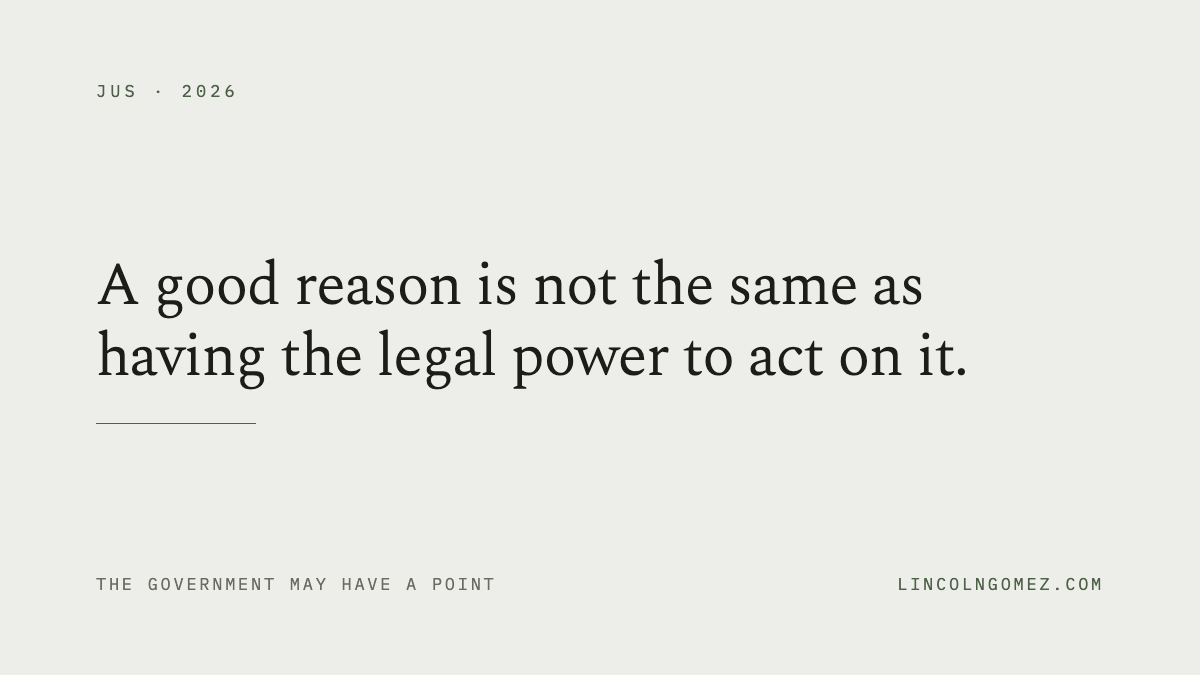
For me, this is the heart of the judgment. Government may have perfectly legitimate concerns about another hotel being built. DNM may have legitimate concerns about the cumulative pressure of tourism on our ecosystems. There may be very good reasons to protect archaeological sites, water systems and ecological corridors. But a good reason is not the same as having the legal power to act on it in every administrative decision.
If tourism development has reached a point where Aruba needs to say enough is enough, then let us have that discussion. If certain areas should no longer be developed, protect them. If our planning legislation is inadequate, change it. If our nature legislation no longer reflects what we believe needs protection, modernize it. Those are legitimate policy choices for government and Parliament to make.
Government cannot wait until the relevant permits have already been granted and then use another statutory power to revisit considerations that belong elsewhere. The Court also notes that the Nbv provides a mechanism for designating an area as a nature reserve. This particular project area has not been designated as one. Government cannot have it both ways.
There is also a question government should ask itself that goes beyond this particular court case: how did we get this far? Ibersol has an erfpacht agreement with the Land, a building permit and an aanlegvergunning. Yet at what is effectively the last hurdle before construction, government is raising broader objections about tourism growth, sustainable development and the ecological value of the area. Whatever one's view of this hotel, that is not good government planning. If a development is unacceptable for Aruba, the moment to address that is before government grants the land and the relevant development permits, not after an investor has gone through the process and reached the final door.
Interestingly, this is not the first time the Aruban Court has drawn this line in an environmental case. In the Parkietenbos incinerator case, the Court rejected an attempt to bring considerations from the Natuurbeschermingsverordening and the ROPv into a decision under the Hinderverordening. Now, in Ibersol, we essentially see the reverse. The message is remarkably consistent: each law has its own purpose, its own protections and its own decision-making framework. Government cannot simply mix them together when the desired outcome requires it.
This Is Not a Judgment Against Nature
People will inevitably see this case as developer versus environment. I think that misses the point. The Court did not say that protected flora and fauna are irrelevant, nor did it say that Ibersol is automatically entitled to its exemption. Instead, it instructed the government to investigate the things the Nbv actually protects.
The competent minister must determine how construction will affect the protected plants and animals on the property, whether those plants and animals are significant for maintaining their species, and what significance they have for other flora and fauna in the area. Importantly, the minister must also obtain advice from the scientific authority required under the Nbv. That advice had not been obtained. The government explained that an institution in Curaçao had been designated as the scientific authority but, for technical reasons, could not provide advice. The Court did not consider that sufficient.
There is an interesting detail here. Ibersol also argued that DNM had been biased, pointing to wording in its advice that could suggest the requested outcome was already known. The Court did not accept that argument and therefore did not find that DNM was unlawfully prejudiced. It did, however, describe the wording as “hoogst ongelukkig geformuleerd” and expressly connected this to the importance of obtaining independent advice from the scientific authority. That is not a finding of bias, but it is certainly something government should take seriously.
The judgment also addresses Ibersol's Environmental Management Plan, which describes how it could relocate protected flora and fauna. The government had not properly considered that plan. The Court says that it must do so because the Nbv allows conditions to be attached to an exemption. The minister therefore must examine whether conditions, including relocation, can reduce the impact on protected plants and animals. The choice is not automatically between allowing everything and prohibiting everything. Good regulation requires government to identify the interest the law protects, determine the actual risk to that interest, and then consider whether that risk can be properly managed. If it cannot, government may have grounds to say no. But if it can, the law expressly gives government the ability to impose conditions.
And Then There Is the Policy Nobody Can Find
One detail in the judgment particularly caught my attention. At the hearing, the government confirmed that an existing policy governs exemptions under the Nbv and that it still applies. According to the judgment, however, that policy is no longer available through government websites.
That should concern us. The government apparently uses a policy when deciding whether citizens and businesses qualify for an exemption, yet the people whose applications are being judged cannot readily find it. The Court's response is refreshingly uncomplicated: if the minister has an exemption policy, the minister must apply it or explain why the government is departing from it.
This should not require a court judgment to remind us. Rules and policies that government applies to citizens and businesses should be accessible to those citizens and businesses. Transparency is not publishing something somewhere once upon a time. Legal certainty means that people should be able to know the rules the government intends to apply to them.
There is another reason this matters. A published policy allows us to see whether similar applicants are being treated similarly. An invisible policy makes that almost impossible. Government discretion is sometimes necessary, but discretion without transparency quickly creates questions about consistency, equal treatment and, ultimately, trust.
The Bigger Question
So, did Ibersol win? Yes, but the final chapter has not been written. The Court annulled the government's decisions and ordered the competent minister to decide again within three months. The minister could still refuse the exemption, but this time the government will have to do its homework. The right minister must make the decision, the government must focus on the interests the Nbv actually protects, the scientific authority must be consulted, Ibersol's Environmental Management Plan must be considered, the possibility of imposing conditions must be examined, and the government's exemption policy must either be applied or any departure from it properly explained.
That is a substantial victory for Ibersol, but not an automatic victory for the hotel. More importantly, it raises a broader question about how Aruba makes policy. We need a serious discussion about development, tourism, carrying capacity, nature, water management, archaeology, and what kind of island we want to leave to future generations. We cannot keep postponing those difficult policy choices and then expect individual permit procedures to solve them for us.
If we want fewer hotels, make the policy. If we want certain areas protected, protect them. If our laws are outdated, update them. If government believes the public interest requires stronger environmental protections, take those proposals to Parliament and put them into law. But once the law exists, government has to follow it too. Government cannot compensate for gaps in one law by stretching another law beyond the purpose for which it was enacted.
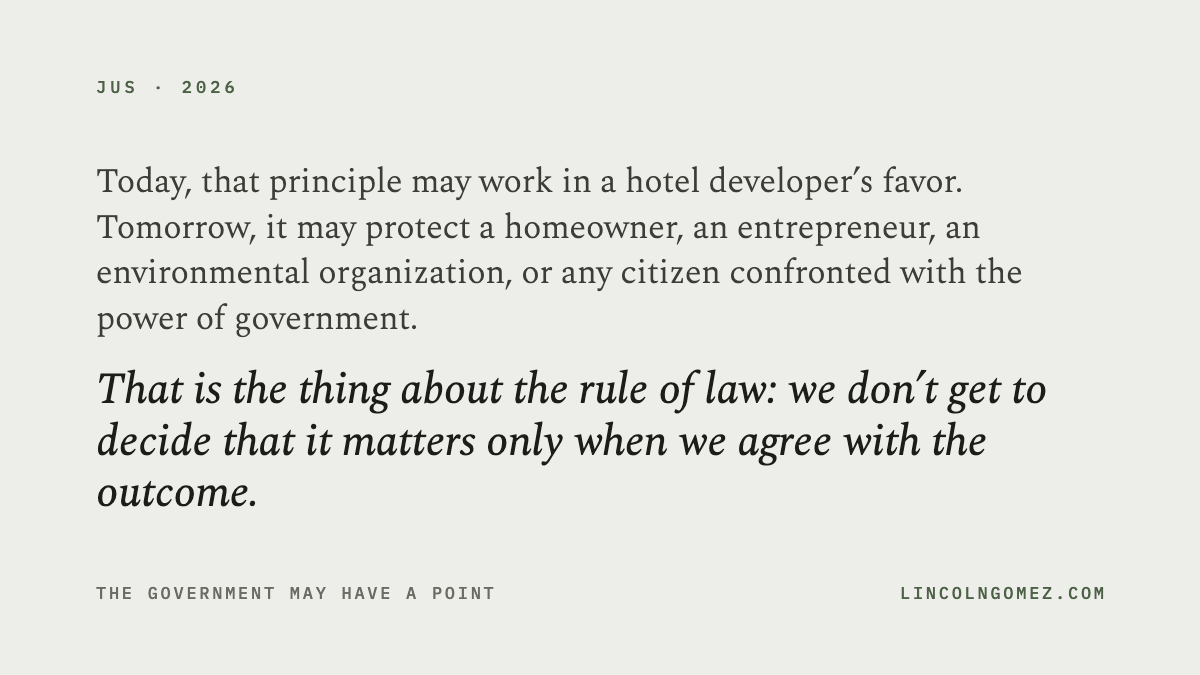
Today, that principle may work in a hotel developer's favor. Tomorrow, it may protect a homeowner, an entrepreneur, an environmental organization, or any citizen confronted with the power of government. That is the thing about the rule of law: we don't get to decide that it matters only when we agree with the outcome.
Have a great week, everyone, and I will see you again next week. In the meantime, visit lincolngomez.com to find all my blogs and podcasts.
7 October 2026