Five Years of Listening to San Nicolas

Suzette Dumfries spent five years researching San Nicolas and presented the findings to a sold-out Santa Teresita. Somewhere between Isaac Wagenmakerstraat and that room, the research became personal.
Somewhere Between Isaac Wagenmakerstraat and Santa Teresita
The presentation started at six in San Nicolas. I live in Noord. Ironically, so does Suzette. On that particular evening, we were both making our way from Noord, on the western side of the island, to San Nicolas in the east.
I knew that if I left home around 4:35 and tried to get through town, traffic would probably make it difficult to arrive on time. So I had made a different plan. I would leave much earlier, avoid the traffic, spend some time with my uncle David in San Nicolas, and then go to Santa Teresita.
My uncle David was born and raised on Isaac Wagenmakerstraat. Today he lives across the street from where my grandfather once lived. I sat with him for a while, together with some of his grandchildren who were visiting. Then I went to the presentation.
At that moment, these were simply two things I had planned for my afternoon and evening. Spend some time with my uncle and then go listen to Suzette.
A few hours later, I realized how closely the two were connected.
A Daughter of Aruba
At the beginning of her presentation, Suzette Dumfries described herself as a daughter of Aruba. I liked that description.
Suzette is from Rancho, from Playa. She has lived and worked abroad for many years, including in the Middle East. She is an economist, but her professional experience goes beyond economics. Part of her work abroad has involved nation-building, assisting governments and policymakers in developing countries and communities. She gained knowledge and experience abroad and brought that experience home.
For approximately five years, this daughter of Aruba has focused her attention on San Nicolas. And when I say focused, I mean researched. She conducted interviews, gathered data, worked with samples that, as she explained, exceeded the minimum necessary to produce statistically relevant results, went through archives, studied the history of San Nicolas and Lago, and examined the many plans produced over the years in the name of developing San Nicolas.
She wanted to know what had been proposed, what had been attempted, what happened to those plans and, importantly, why so much of it never happened. Most importantly, she asked the people of San Nicolas what they wanted.
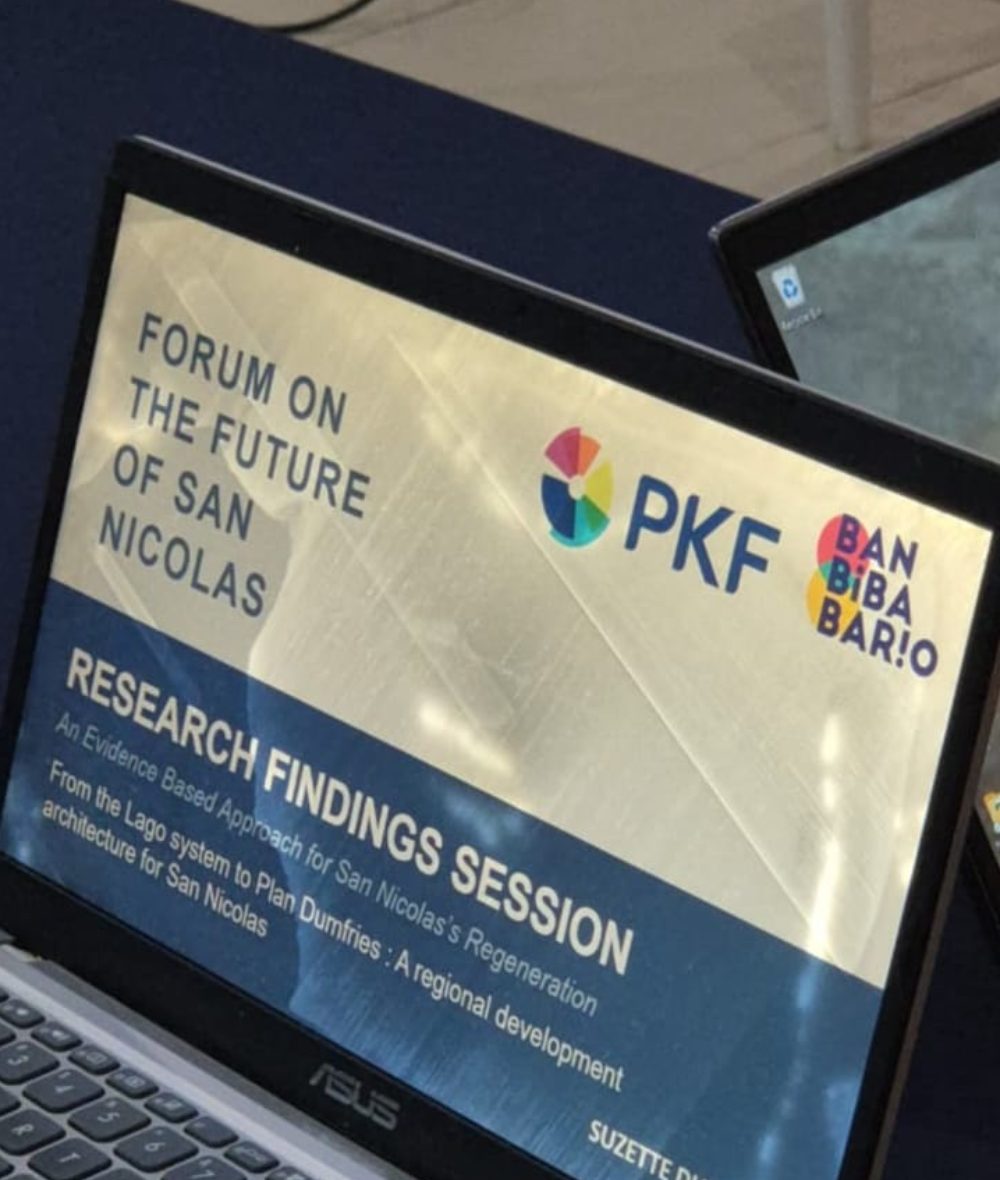
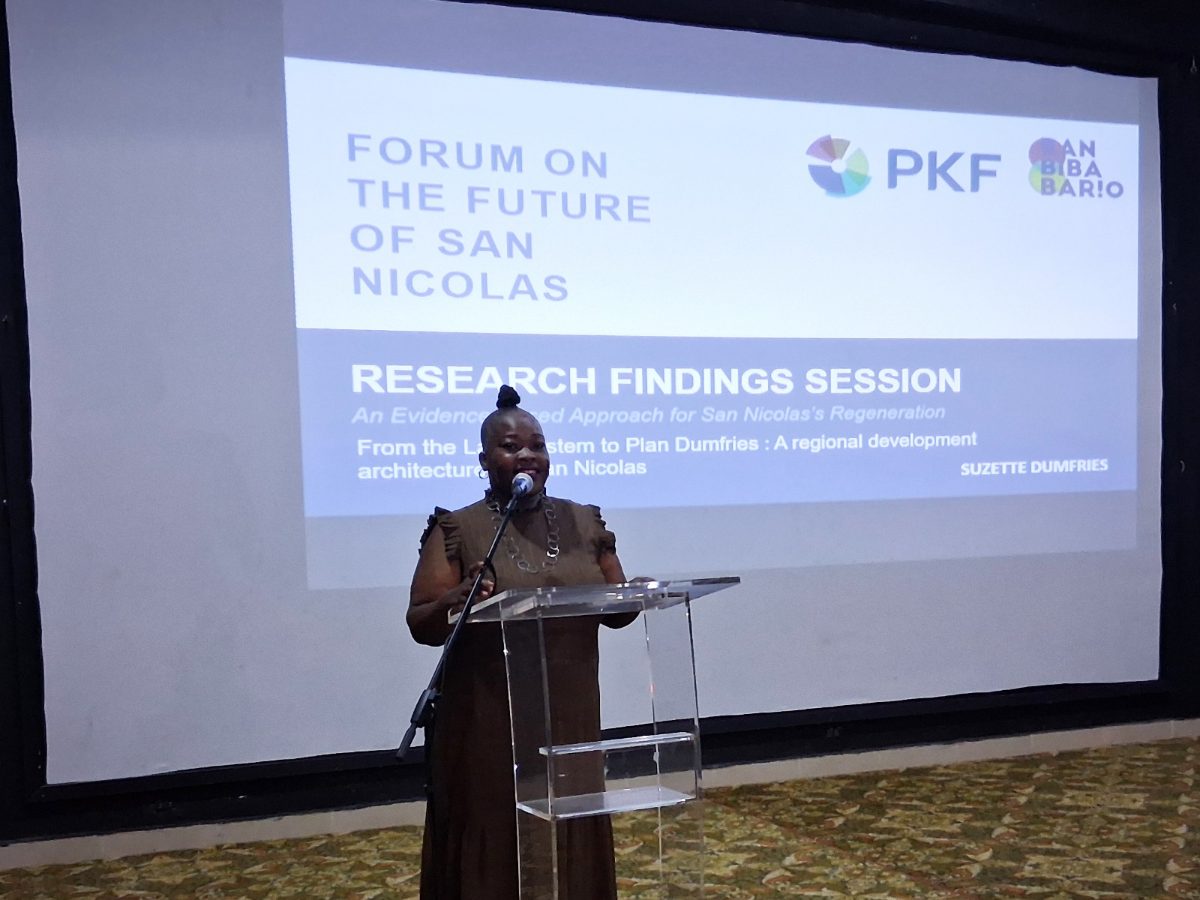
Suzette presented the results of those five years of work at the Santa Teresita Center in San Nicolas. She held the presentation on three separate evenings to give more people an opportunity to attend. I attended the first night, which was sold out. Residents of San Nicolas were there; people with roots in San Nicolas were there; ministers and policymakers were there; investors and business leaders were there; and others interested in the future of San Nicolas were there. I was one of them.
Suzette and I attended the same school decades ago and reconnected relatively recently. We were not classmates, and after school we each went our separate way. She had shared some of her thoughts and research with me, so I knew a little about what was coming. But hearing bits and pieces privately is one thing. Seeing five years of research presented together is something else.
The presentation itself was very much Suzette. What you see is what you get. She wasn't on the stage. She sat in front of it. Whether that was intentional or she simply forgot there was a stage, I don't know. There were no fancy effects. There was a large screen behind her containing far more research than she could possibly cover in one evening, so she gave us the highlights.
One in particular resonated with me.
Lago Was More Than a Refinery
Suzette then dissected what Lago actually meant to San Nicolas.
We tend to remember Lago as an oil refinery. Oil, jobs, and economic activity. But Lago was much more than a refinery. It provided wages and pensions, housing, transportation, medical care, and scholarships. There was the commissary and access to supplies. There were recreational facilities, including the Colony Bowling Club. Lago actively participated in Carnival and the community's social life.
And then there was the Lago horn.
Those old enough to remember will know exactly what I mean. The horn blew at set hours during the day and could be heard from far away. For the workers, it signaled the beginning or end of a shift. But it wasn't only the workers who heard it. Their families heard it. The neighborhoods heard it. San Nicolas heard it.
In a very literal way, Lago helped set the rhythm of daily life in San Nicolas. It was not simply an industrial operation located there. It helped shape and organize the larger community around it.
That distinction becomes important when we look at what happened afterward. After Lago closed, other operators came and reopened the refinery. Their focus was primarily on refining oil. That is not criticism. But the refining activity did not necessarily bring back everything else that had existed around Lago, including the housing, scholarships, transportation, social structures, recreation, community involvement, and the broader infrastructure that had developed around the refinery.
Suzette therefore raised an interesting question. When people say they want the refinery back, what exactly do they want back? Perhaps they are not only talking about refining oil. Perhaps they miss what came with it. Perhaps they miss the opportunities, the support structures and the possibility that a job could create opportunities not only for you, but for your children.
That hit a chord with me.
My Family and Lago
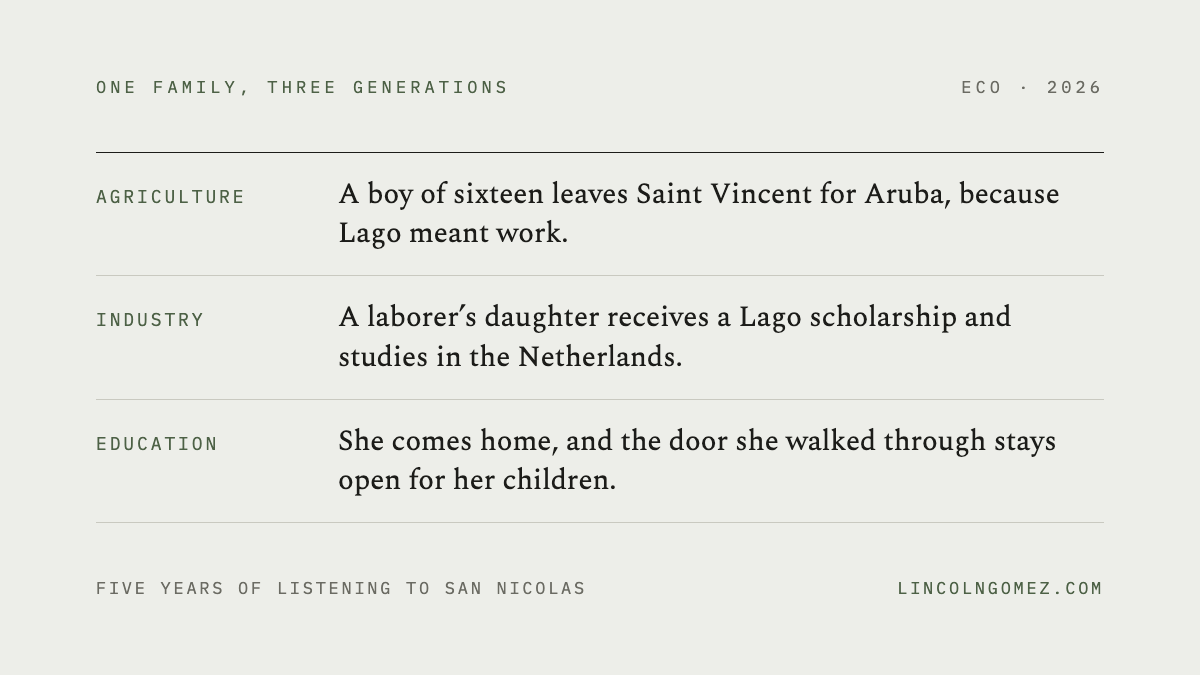
My grandfather was of British descent. His family had settled in Saint Vincent and the Grenadines, where they were involved in agriculture. His elder brother came to Aruba in search of opportunities. Lago was here. There was work. And from Aruba came the message to his younger brother to come, because there was an opportunity here.
So, at 16 years old, my grandfather left Saint Vincent and the Grenadines for Aruba. He left agriculture and entered industry. He started working at Lago, formed a family here, and never left. Aruba became home. He lived here for the rest of his life, passed away here, and was buried here.
Sitting at Santa Teresita, I realized that my grandfather was part of the very history Suzette was describing. He was one of those people who came to Aruba because Lago represented opportunity.
My grandfather was a laborer at the refinery. His eldest daughter was my mother. Because her father worked at Lago, my mother received a Lago scholarship, which enabled her to pursue higher education in the Netherlands.
Then she came back to Aruba, continued her life here and raised her family here. Because education had opened a door for her, she made sure that door remained open for her children. I was one of them.
That gave me the opportunity to pursue higher education and, ultimately, the privilege of sitting down every week to share my thoughts and writing with you through these columns.
Think about that journey. A family of British descent settles in Saint Vincent and the Grenadines. A 16-year-old boy leaves agriculture in Saint Vincent and comes to Aruba to work in industry. His daughter receives a scholarship and leaves Aruba to study in the Netherlands. She comes home, and the opportunity continues into another generation.
Agriculture became industry. Industry created access to education. Education created further opportunity.
Suddenly Suzette's research was no longer simply something appearing on the screen behind her. Part of it was my family's story.
What Are We Really Trying to Replace?
That family history helped me understand another important part of Suzette's message. If we want to create a new economic future for San Nicolas, it is not enough to ask what economic activity can replace the refinery.
Suppose, for example, we decide that hotels and tourism should become part of that future. They may create jobs, bring investment, and generate economic activity. But will they also provide the type of infrastructure that Lago once provided around itself? Will they create opportunities beyond the job itself? Will they contribute to education? Will they provide other benefits to the community?
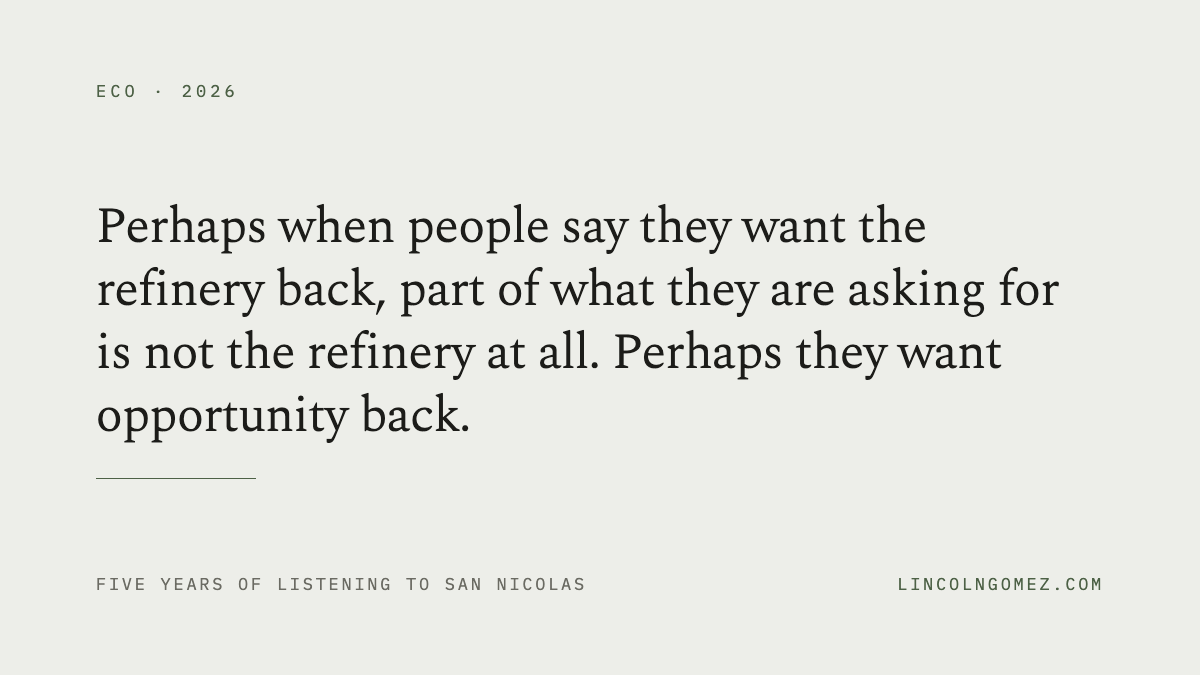
If the answer is no, then replacing one industry with another does not necessarily replace what disappeared. Perhaps when people say they want the refinery back, part of what they are asking for is not the refinery at all. Perhaps they want opportunity back.
Nobody Owned the Execution
Suzette also took us through the many plans that have been presented over the years for the development of San Nicolas. There have been plenty. Her research showed, however, that many were not, in fact, plans for San Nicolas as a whole. They dealt with a particular area, district, or project. Bits and pieces were presented as plans for San Nicolas, rather than a plan for San Nicolas as a whole.
There was another recurring problem. Plans were presented, renderings were shown, pictures were taken, and reports were filed. Then too many of them disappeared.
Why?
Suzette's conclusion was simple.
Nobody owned the execution.
There was no entity responsible for taking the plan and carrying it forward. No proper legal anchoring, governance structure or sustainable funding mechanism. A good idea is not enough. Somebody has to own it. Somebody has to execute it. And there has to be a way to fund it.
It also doesn't help that for too long we have had an unfortunate tradition whereby a change in administration can mean stopping what the previous administration was doing rather than continuing what works and improving what needs improvement.
San Nicolas cannot keep starting over.
Let San Nicolas Be San Nicolas
Another part of Suzette's research deserves attention. She asked the people of San Nicolas what they wanted.
That sounds obvious, but you cannot build San Nicolas into something the people of San Nicolas do not want. Her research included different age groups and samples that she explained were statistically relevant. One message came through clearly. Do not turn San Nicolas into another Noord.
People want development and opportunities, but they do not want over-tourism or over-touristification. They want their identity preserved. They want authenticity. They do not want Disneyland.
And perhaps that identity is one of San Nicolas' greatest strengths.
Suzette argues that San Nicolas has something extraordinary. The Caribbean is already there. You find people and families with roots in Saint Vincent and the Grenadines, Jamaica, Trinidad, Barbados, Suriname, Puerto Rico, the Dominican Republic, Cuba, Colombia and elsewhere, all gathered in one relatively small community.
You can go to London and other places and find Caribbean communities, but Suzette's proposition is that in San Nicolas you find virtually the entire Caribbean represented in one place. If you want to experience the Caribbean, come to Aruba and go to San Nicolas.
Again, I thought about my grandfather. He was part of how that happened. He came from Saint Vincent because Lago represented opportunity. Others came from elsewhere in the Caribbean for the same reason. They came to work, stayed, formed families, and became part of Aruba.
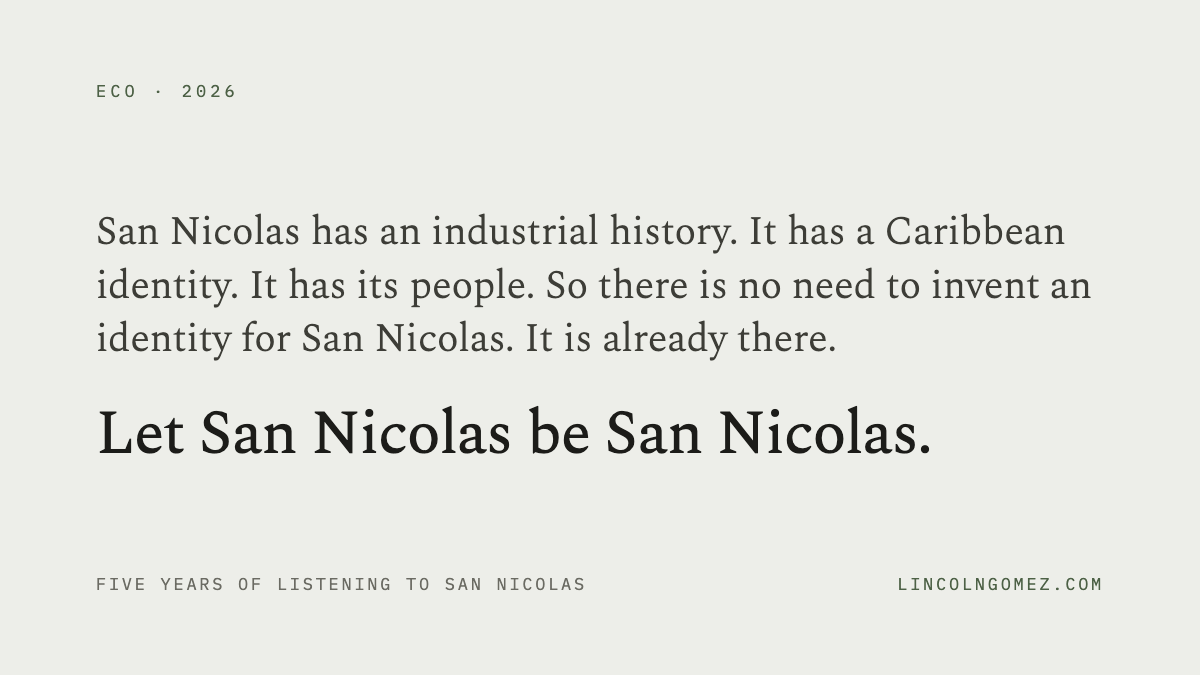
So there is no need to invent an identity for San Nicolas. It is already there.
Recognize it. Document it. Give it structure. Create opportunities around it. Preserve its authenticity. And don't ignore the industrial elements that are already there either. It does not have to be one or the other.
San Nicolas has an industrial history. It has a Caribbean identity. It has its people.
Let San Nicolas be San Nicolas.
Then She Handed Me the Microphone
At some point Suzette decided she had said enough. Now she wanted to know what we were going to do with what we had heard.
She asked the room what we would do with the information we now had. What would we do individually?
I was still pondering that when she called my name, and somebody handed me a microphone.
Thanks, Susie.
I wasn't ready. I was still digesting what I had heard. I told her why the discussion about Lago had resonated with me. I spoke about my grandfather, my mother, and the Lago scholarship.
Then I remembered another part of her presentation.
Part of Suzette's proposal is the establishment of a foundation for the stadsvernieuwing, the urban renewal of San Nicolas. That foundation is intended to address precisely one of the problems she identified in all those previous plans.
Somebody has to own the execution. There needs to be a legal entity, governance, continuity, and funding.
So I finally had my answer to Suzette's question.
I told her that if she allows me, I will contribute the necessary funding to establish the foundation so that this part of the work can get started.
That was my concrete contribution.
I said it with a microphone in my hand in front of a sold-out Santa Teresita, so I guess there is no backing out now.
And that is fine.
Susie, I am in.
Join Her
Those three evenings have now passed. The research has been presented. Residents heard it. People with roots in San Nicolas heard it. Ministers and policymakers heard it. Investors and business leaders heard it.
Now comes the more important question. What are we going to do with it?
Nobody has to agree with everything Suzette proposes. That is not the point. Five years of interviews, statistical analysis, archival research, community consultation, and examining plans that came and went deserve serious consideration.
Policymakers should consider where the research can inform policy and, where appropriate, adjust their sails. Investors and business leaders should consider where they fit. Those with knowledge and experience that can contribute should consider what they can bring.
Suzette's objective is not simply to present research. She wants to do more nation-building, here at home, in Aruba. She has chosen to focus that effort on San Nicolas.
That afternoon, before the first presentation, I sat with my uncle David and some of his grandchildren across the street from where my grandfather once lived. A few hours later, I listened to Suzette explain how Lago had helped shape San Nicolas and the generations that followed.
Somewhere between Isaac Wagenmakerstraat and Santa Teresita, the research became personal.
My grandfather came to Aruba because Lago represented opportunity. That opportunity reached my mother. Through her, it reached another generation.
Suzette asked me what I was going to do with what I had heard. I found my answer.
Now find yours.
Nation-building is not something we should sit in an audience and watch somebody else do. It requires participation.
Don't watch her.
Join her.
15 August 2026