
Aruba's New Building Regime: In Force, But Not Yet Finished
Aruba's 2022 building ordinance gave government enforcement powers, but the rules telling citizens where they stand are still missing.
In 2022, Aruba replaced a building regime with roots reaching back to 1935. The Bouw- en sloopverordening was intended to modernize the rules governing construction, use, and demolition, while giving government stronger tools to enforce them.
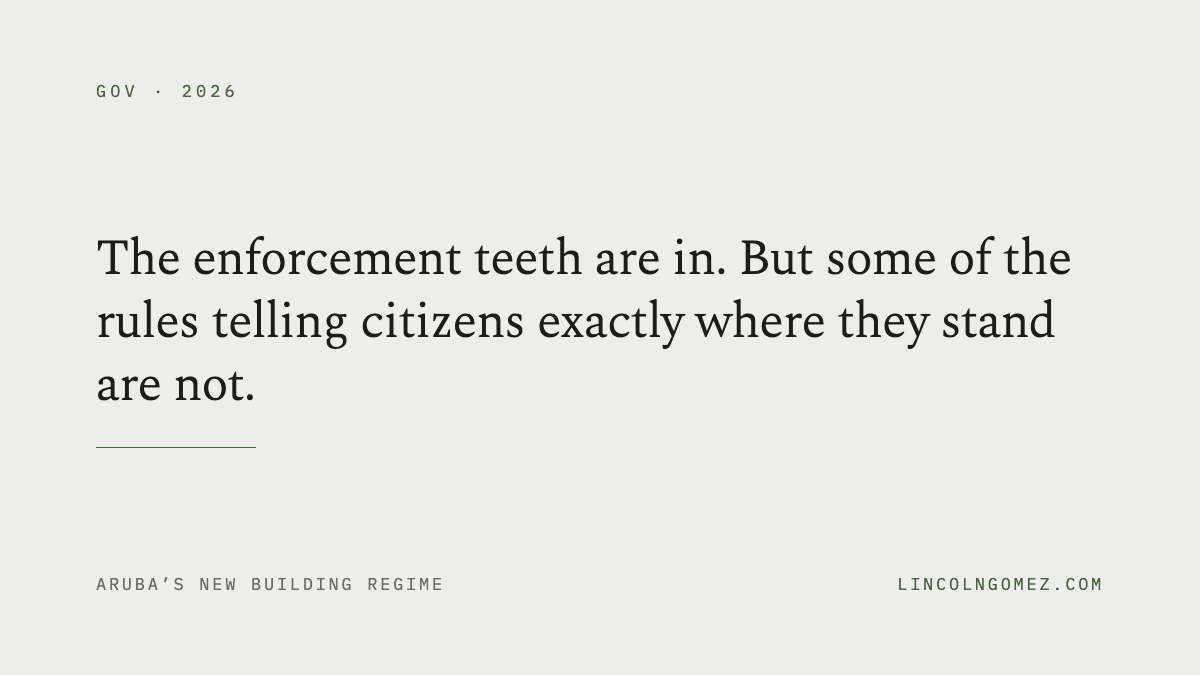
Four years later, much of that system is operational. Permits are required. Applications can be refused - but only on the specific grounds the law allows. Violations can be sanctioned. But important parts are still missing. That creates an uncomfortable imbalance: the government's enforcement powers are largely in place, while some of the rules telling citizens exactly where they stand are not.
The Teeth Are In
The ordinance was introduced in stages.
The Landsbesluit Welstandscommissie established the committee responsible for assessing aesthetics. Then Bouw- en sloopbesluit I regulated permit applications, drawings, engineering calculations, accepted engineering standards, and matters such as setbacks from property boundaries. Importantly, the permit requirement itself also became effective in 2023.
On January 1, 2026, the enforcement chapter became operational. DOW can now impose an order subject to a penalty of up to Afl. 250,000, declare a structure unfit for use, suspend a permit, and apply administrative coercion. Administrative fines can reach Afl. 50,000 for a natural person and Afl. 250,000 for a legal person. In other words, the enforcement teeth are in. But some important boundaries are still being drawn.
Three Pieces Are Still Missing
A review of the published legislation through August 26th, 2026, reveals three important gaps. First, there is no operative exemption threshold for minor construction.
Article 3 anticipates rules identifying works of “limited significance” that could be permit-free or require only notification. Those rules have not been enacted, and article 3 itself is not yet in force. The new regime therefore provides no published threshold based on size, area, or height allowing an ordinary citizen to determine when minor construction does not require a permit. A homeowner considering a small structure should be able to answer a basic question: Do I need a permit or not?
Second, the modern technical building requirements remain incomplete. Today's application rules require modern engineering calculations, while transitional provisions leave important structural-safety requirements rooted in the old Bouw- en woningbesluit. We therefore have one foot in a modern permitting system and another in rules inherited from another era.
Third, the aesthetic criteria have not been published.
A Committee Without a Published Yardstick
This last point deserves particular attention. Article 10 allows a permit to be refused where the Welstandscommissie concludes that a building conflicts with the “redelijke eisen van welstand” referred to in article 6, first paragraph. Yet those criteria have not been published. Moreover, the decree establishing the Welstandscommissie requires that its objections be based on criteria set out in legislation and published policy.
So what published yardstick is the citizen supposed to use?
Aesthetic judgment will always involve some subjectivity. Published criteria do not eliminate judgment, but they put boundaries around it. They tell the committee what to consider, tell applicants what is expected, and provide a benchmark against which decisions can be compared and reviewed.
Without those criteria, two substantially similar applications could receive different assessments, leaving applicants without a published benchmark to understand why. The issue is not whether the committee will make good or bad decisions. The issue is whether the citizen can know in advance which standards will be applied. If the legislator decided that criteria were necessary, those criteria should be published.
Accessible, But Still Complicated
There is another aspect of this that became apparent while researching this column.
To its credit, DOW has made the legislative changes available on its website. Its building permit page brings together several documents concerning the Bouw- en sloopverordening and Bouw- en sloopbesluit, together with practical information about permit applications and the procedure. That is important, and it deserves to be acknowledged.
But even with those materials available, piecing together the complete legal picture took me, as a trained and experienced legal professional, several hours. The difficulty is not simply finding documents. It is determining how they fit together: what is old, what is new, what remains applicable under transitional provisions, what has entered into force, and what the legislature contemplated but has not yet been implemented.
For the average citizen, that remains a formidable task. We expect citizens to know and obey the law. It follows that we should make it reasonably possible for them to understand which law applies to them today. DOW has taken an important step by centralizing information. I would encourage it to go one step further and provide a simple, regularly updated overview explaining the current legal position: which provisions are in force, which older rules remain applicable during the transition, and which implementing regulations are still outstanding.
Accessibility Cannot Replace Missing Rules
But there is an important distinction.
You can make existing legislation easier to find and explain. You cannot publish an explanation that substitutes for implementing regulations that have never been enacted. That remains the central problem.
The rules for minor works contemplated by the ordinance are still outstanding. The modern technical framework remains incomplete. And the published aesthetic criteria contemplated by the legislation are still missing. Those are not website problems. They are unfinished legislative work. The next step should therefore be to complete the framework the legislature itself contemplated. Legal certainty requires that both citizens be able to find the rules, and that the rules themselves be complete.
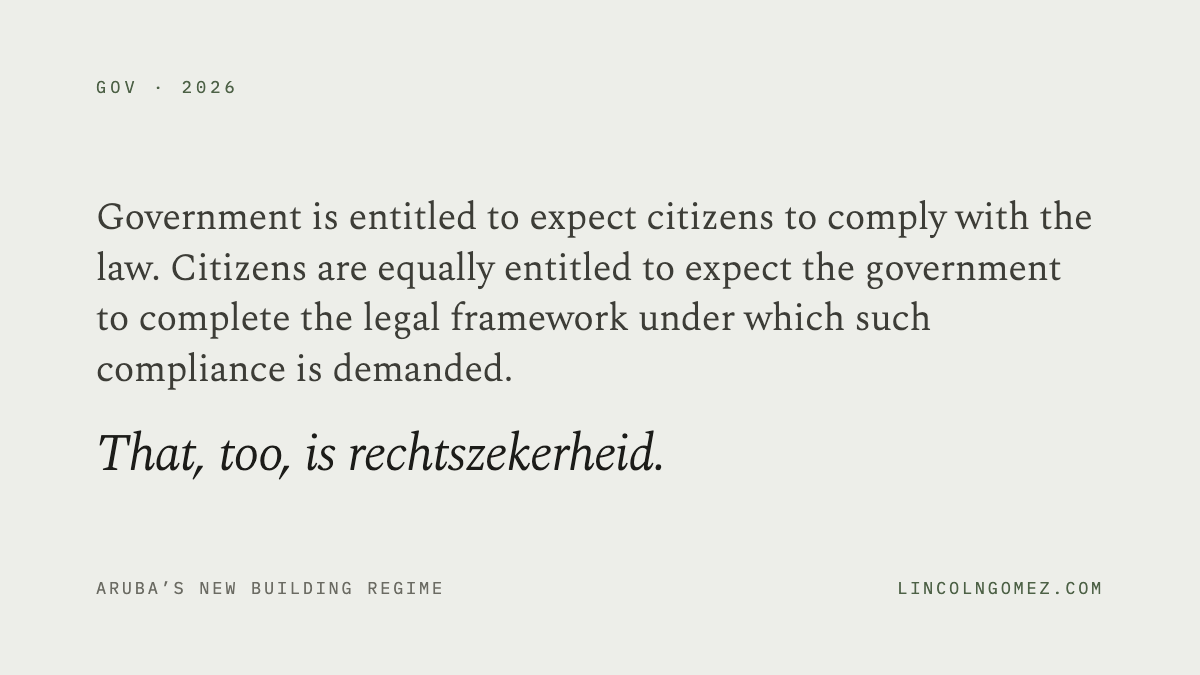
Government is entitled to expect citizens to comply with the law. Citizens are equally entitled to expect the government to complete the legal framework under which such compliance is demanded.
That, too, is rechtszekerheid.
Have a great week, and I will see you again next week.
In the meantime, keep building a better future for the community, and visit www.lincolngomez.com to find all my blogs and podcasts in one place.
29 August 2026