Aruba Had a Plan for Nature. What Happened to It?

In October 2024 the Council of Ministers approved Aruba's biodiversity strategy through 2030. It phases out UTVs and puts nature first. So what changed?
In October 2024, the Council of Ministers approved Aruba’s National Biodiversity Strategy and Action Plan 2024–2030. It is called “Harmonizing People and Nature” and reading it today is quite an interesting exercise. Not because it is an old document. Quite the opposite. It is barely two years old, and it tells us what Government believed Aruba needed to do about nature between 2024 and 2030\.
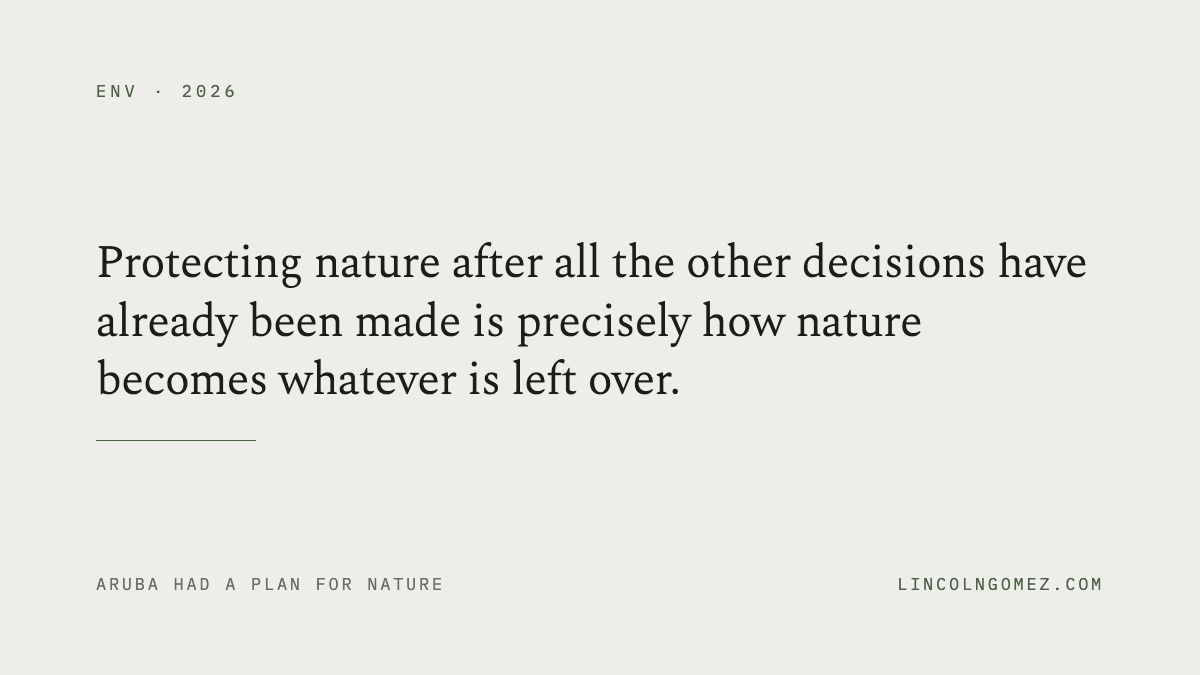
The document is ambitious, but its message is simple. Aruba’s nature is under serious pressure, development has consequences, tourism depends on the very environment it can damage, and Government needs to make different choices if we want to preserve what is left. Perhaps most importantly, the NBSAP says nature should no longer be an “afterthought” in our development, something to be considered after everything else has already been decided. Instead, nature should become part of the foundation of Aruba’s future development.
That was October 2024\. So perhaps it is time to ask a very simple question: what changed?
A Government That Recognized the Problem
The NBSAP does not paint a particularly comfortable picture of Aruba. It identifies urbanization, coastal development, pollution, climate change, unsustainable tourism, and high-impact recreation among the pressures on our ecosystems. It notes that Aruba’s built environment grew from 29 square kilometers in 1986 to 60 square kilometers in 2020, approximately one-third of the island. Stakeholder consultations also concluded that Aruba has already surpassed its carrying capacity.
That last statement deserves attention. We frequently discuss carrying capacity as though it were an abstract concern raised only by environmental activists. Yet here it appears in a biodiversity strategy approved by the Council of Ministers.
The report also recognizes the uncomfortable relationship between tourism and nature. Aruba’s economy depends heavily on tourism, but tourism depends heavily on Aruba’s beaches, landscapes, reefs and other natural assets. Destroy enough of the product, and eventually there is less product to sell. The NBSAP therefore argues for a transition toward “High Value, Low Impact” tourism and expressly states that further regulation and enforcement of irresponsible and unsustainable tourism development is necessary.
Again, those are not my words. They are in the Government-approved strategy.
The Plan Did Not Stay Entirely on Paper
The Government has already started implementing parts of the NBSAP. In July 2025, it launched the Aruba Reforestation Project, an initiative to plant 100,000 trees around the island over four years. The government itself described the project as part of the NBSAP 2024–2030. The trees are intended for urban and rural areas, including neighborhoods, schools, and public spaces, with stated benefits ranging from additional shade and lower temperatures to reduced sedimentation on coral reefs and greater protection for biodiversity.
This matters because it shows the NBSAP is not simply a document sitting on a shelf. The Government is already relying on it as the basis for concrete action. And that makes consistency in its implementation all the more important. If the NBSAP guides the Government when it plants trees and restores nature, it is reasonable to ask how the same strategy guides the Government when it considers activities that the NBSAP itself identifies as harmful to nature.
And Then There Are the UTVs
The discussion becomes particularly relevant considering the current debate about motorized tourism in our nature areas.
The NBSAP specifically identifies off-road driving by UTVs and ATVs as high-impact recreation. It describes environmental consequences including dust damage to vegetation, habitat fragmentation, sedimentation into watershed systems and the ocean, disturbance of fauna, roadkill and oil pollution. The report supports these conclusions with research on the effects of off-road driving.
The NBSAP's direction is remarkably specific. UTVs and ATVs are to be phased out by 2030\. No new permits are to be issued. The NBSAP prohibits replacing old vehicles with new ones. Until 2030, only three routes are to remain available, after which the report says the activity will no longer be legal in Aruba.
And this is where the NBSAP becomes particularly relevant today. Less than two years ago, Government approved a strategy that identifies UTVs and ATVs as high-impact recreation, documents their environmental damage, limits the activity to three routes during a transition period and says it will be phased out by 2030\. If we are now discussing opening additional nature terrain to that same activity, there is an obvious question Government should answer: what changed?
The ROPV Is Part of the Same Story
The connection with our spatial planning rules is also important. The NBSAP itself discusses the ROPV. It specifically identifies “Natuur en Landschap” as a zone dedicated to nature and explains that the restrictions applicable to that zone and protected areas are intentionally identical in order to safeguard nature and its ecosystem services.
That makes it difficult to treat the ROPV and biodiversity policy as two unrelated subjects. The Government itself connected them.
This is particularly relevant after the Government extended the existing ROPV until July 17, 2029\. We now have a binding spatial plan running through 2029 and a Government-approved biodiversity strategy running through 2030\. Both deserve to be read together when decisions are being considered about the future use of our remaining natural areas.
The NBSAP sets a clear direction. Aruba aims to protect 30 percent of its terrestrial, coastal and marine areas by 2030 and restore 30 percent of degraded terrestrial, coastal and marine ecosystems. The strategy therefore looks toward greater protection, restoration and lower-impact use of our limited natural resources.
Proposals that appear to move in another direction deserve an explanation.
Government Even Gave Itself a Standard
Perhaps one of the most interesting parts of the NBSAP is its precautionary principle. The document says the Government has a duty of care to enable urgent and transformative action to halt and prevent biodiversity loss. It says that development choices that undermine the value of nature and the wellbeing of Aruba’s people are not acceptable, and that scientific uncertainty should not become a reason to postpone measures that benefit nature.
Those are strong commitments. Government did not merely identify the problems facing Aruba’s nature. It also set a standard for how it intended to respond. Once Government adopts a strategy containing commitments like these, the public is entitled to expect that future decisions will be consistent with that strategy, or that Government will explain why a different course has become necessary.
This is not necessarily a question confined to a policy debate. If a future Government decision affecting a nature area were challenged, a court could very well ask how that decision was reached, what interests and evidence were considered, and how the Government reconciled its decision with the policies and environmental objectives it had previously adopted. The NBSAP may not dictate the outcome of such a case, but the Government's strategy could become part of the context against which the quality and consistency of its decision-making are examined.
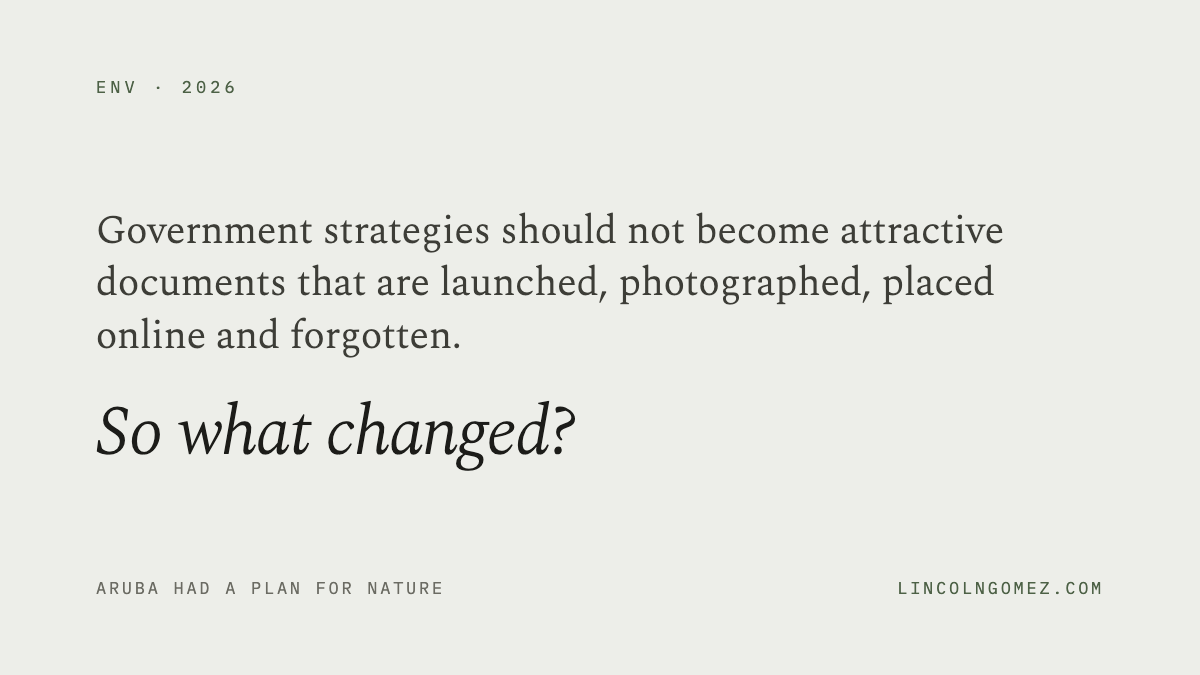
That is precisely why Government strategies matter. They should not become attractive documents that are launched, photographed, placed online and forgotten. Their value is ultimately measured by what happens after approval, when difficult decisions must be made and competing interests weighed.
What Changed?
Governments are allowed to change policy. Circumstances change, evidence develops, and sometimes yesterday’s decision no longer makes sense today. Changing course is not irresponsible when there is a good reason to do so. The responsibility lies in explaining the change.
That is why the question here is not whether Government is forever bound to every sentence written in the NBSAP. The question is whether the circumstances, evidence or policy have changed since the Council of Ministers approved it in October 2024\. If they have, Government should tell us what changed and why. If they have not, then Government should explain how opening additional nature terrain to high-impact motorized tourism fits within a strategy that calls for exactly the opposite direction.
The NBSAP said nature should no longer be an afterthought in Aruba’s development. That may ultimately be the most important promise in the entire document. Because protecting nature after all the other decisions have already been made is precisely how nature becomes whatever is left over.
So before we decide what else we can do in our remaining natural areas, perhaps the first document on the table should be the Government’s own biodiversity strategy.
And then someone should answer the simplest question of all: what changed?
Thanks for reading. Catch you next column \- and don’t forget to visit www.lincolngomez.com for all my latest blogs and podcasts.
13 September 2026